The first room a guest walks into tells them everything. It sets the tone for the entire home — the level of care that went into building it, the design sensibility that guided every finish decision, and whether the people who live there treat their space as a backdrop or as something worth investing in. In most homes, that first room is the entryway. And in most homes, the entryway is the most underserved room in the house.
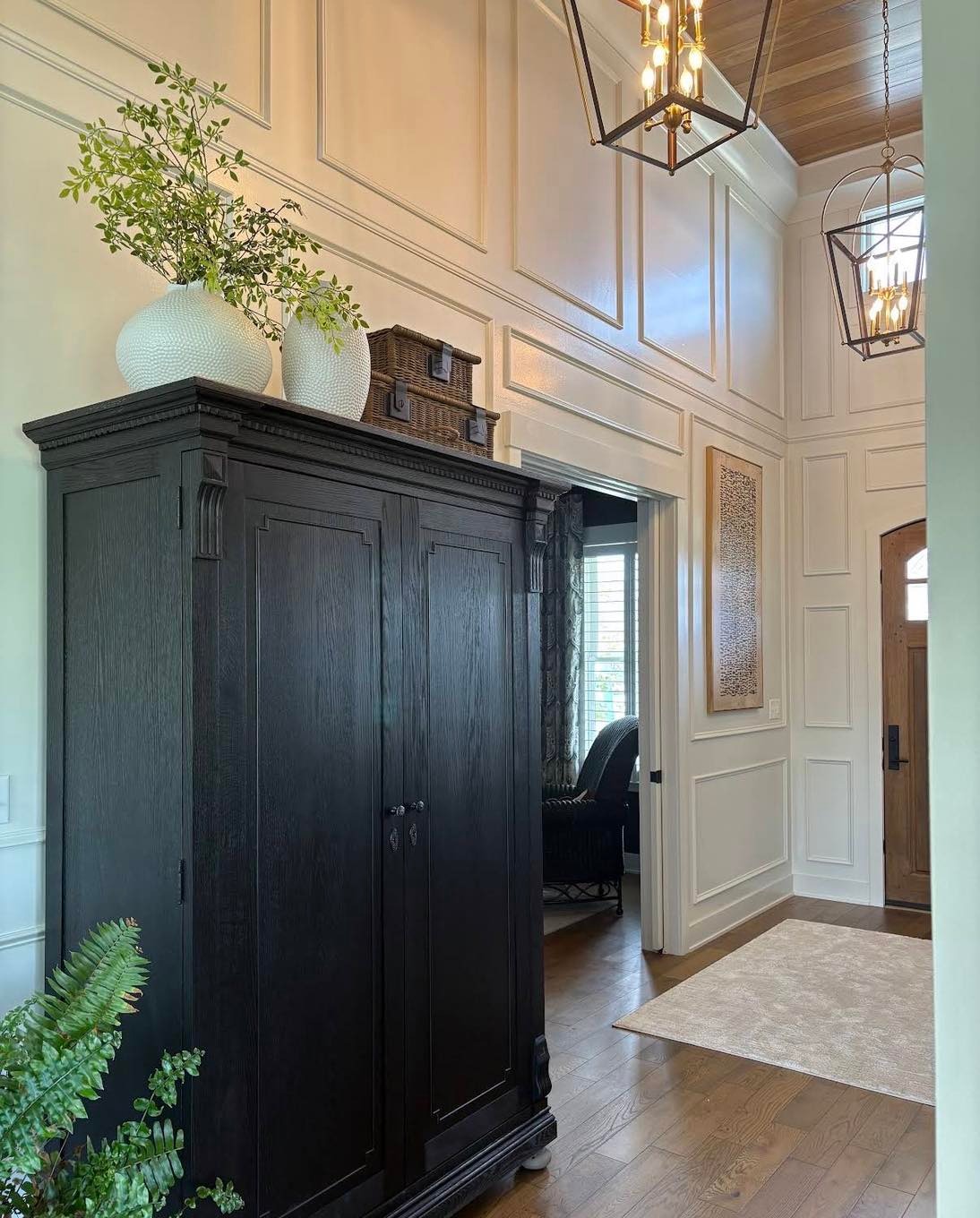
This Zionsville project changed that entirely. The accent wall running the full height of this two-story foyer — built from custom picture frame molding installed in a precise, floor-to-ceiling grid — is the kind of detail that doesn’t announce itself with noise. It simply makes the room feel like nothing you’ve seen in a builder-grade home. Paired with a warm wood plank ceiling, brass lantern pendants, and dark hardwood floors, the molding work gives the entryway a sense of permanence and architectural intention that takes hold the moment you step inside. That’s the install. Once the space is styled and lived in, the full value of a truly custom accent wall reveals itself.
What Makes Picture Frame Molding the Right Accent Wall for a Two-Story Entryway
An accent wall works when it fits the scale of the room it occupies. In a single-story space with standard eight-foot ceilings, a simple board and batten treatment or a wood plank wall can carry the wall with ease. But in a two-story foyer with soaring ceiling heights, the design challenge is different. The wall is so large and so prominent that a treatment that works beautifully at standard height can look sparse, disconnected, or out of proportion when stretched across a double-height surface.
Picture frame molding solves that problem directly. By dividing the wall into a repeating grid of rectangular frames — scaled proportionally to the height and width of the wall — the treatment creates visual structure that reads clearly and confidently at any height. The eye doesn’t struggle to make sense of the surface. The frames give it a clear, organized composition to rest on, and the shadow lines between the molding profiles add depth and dimension that turn a plain wall into an architectural feature.
In 2026, wall molding treatments are among the fastest-growing design requests in residential construction and renovation, with designers citing a broad shift away from flat, single-finish walls toward surfaces with layered architectural detail. Picture frame molding sits at the center of that shift because it accomplishes something that most other accent wall treatments cannot: it brings classical architectural language into a modern home without making the space feel stiff or dated. The treatment is inherently adaptable — the same molding profile reads traditional in a formal colonial-style home and clean and graphic in a more contemporary new build. What changes is the scale of the frames, the weight of the profile, and the finish. What stays constant is the ability to make a wall feel designed rather than simply covered.
1. Floor-to-Ceiling Treatment Makes the Whole Room Taller and More Considered
The decision to run the picture frame molding from the baseboard all the way to the crown is the single most important design choice in this project. Partial-height treatments — chair-rail molding with paneling below and plain drywall above, for example — are a legitimate design approach in rooms with standard ceiling heights. But in a two-story foyer, stopping the treatment at mid-height leaves the upper portion of the wall visually abandoned. The room reads as two separate surfaces rather than one unified composition.
Extending the molding to the full height of the wall solves that problem and adds something beyond it: the vertical lines of the frames draw the eye upward and make the ceiling feel higher than it already is. In a two-story entryway where the ceiling height is already dramatic, that effect is compounding. The room feels taller than its actual dimensions because the accent wall is giving the eye a clear vertical path to follow from floor to ceiling. Guests experience the full impact of the space’s height in a way that a plain painted wall simply cannot produce.
Interior designers consistently identify floor-to-ceiling wall treatments as one of the most effective ways to maximize the architectural presence of a tall foyer or stairwell because they commit fully to the scale of the room. A treatment that extends to the full height is one that respects the room’s proportions and treats the wall as the significant architectural surface it actually is. Half measures produce half results. Full-height molding produces a room that feels complete.
2. Custom Proportions and Spacing Are What Separate This Accent Wall From the Rest
Picture frame molding is not a new idea. It has appeared in American residential architecture for more than two centuries, and the reason it keeps coming back is that it works — it adds order and beauty to a wall in a way that holds up across design eras. But the difference between molding that looks generic and molding that looks exceptional comes down entirely to proportions.
The frame sizes, the spacing between frames, the width of the molding profile, and the relationship between the frames and the room’s architectural elements — doors, windows, crown molding, and baseboard — all need to be calculated specifically for the wall they’re going on. There is no standard template. A frame layout that looks perfect in one foyer will look crowded, sparse, or off-center in another. The only way to get it right is to measure the wall, account for every interruption and constraint, and design a grid that produces balanced, proportional frames across the full surface.
In this Zionsville entryway, the frames are sized and spaced to work with the room’s specific width and ceiling height. The grid reads consistently from the baseboard to the crown, with frames that are neither too tall and narrow nor too short and wide. The molding profile carries enough visual weight to be seen clearly from across the room without being so heavy that it overwhelms the wall’s finish. Every decision about spacing and proportion was made for this specific wall, which is exactly what makes the result look like it belongs to the house rather than like a product that was installed in it.
3. The Finish Ties the Accent Wall Into the Whole Home
An accent wall built from beautiful trim work can still fall short if the finish doesn’t connect it to the rest of the home. The molding and the wall surface behind it need to be painted in a way that honors both the architectural detail and the broader design language of the space. In this project, the entire wall — frames and background — is finished in the same warm white, which is the right decision for this room and this home.
Painting the molding and wall in the same color is a technique that has driven some of the most compelling trim work installations in 2026 because it lets the architectural detail speak through shadow and dimension rather than through color contrast. The frames aren’t defined by a color difference between the molding and the wall. They’re defined by the physical depth of the profile — the way the raised molding catches the light differently than the recessed field behind it. The result is a surface that reads as sophisticated and architectural rather than graphic or decorative.
That finish choice also connects the accent wall to the rest of the home’s design decisions. The warm white flows from the foyer into the adjacent spaces, creating continuity that makes the entire main level feel cohesive. The dark hardwood floors, the brass lantern fixtures, and the warm wood plank ceiling all sit within the same tonal register — organic, grounded, and confident without being loud. The accent wall, finished in the same white as the trim throughout the home, anchors the entry in the language of the full design rather than standing apart from it as a separate statement.
4. The Styled Room Is Where a Custom Accent Wall Proves Its Value
The install is only the first chapter. The reason a truly custom accent wall earns its place in a home is what happens after the tools are packed up — when the room is furnished, styled, and lived in. That’s when the molding work stops being a carpentry project and starts being part of the home’s character.
In this Zionsville foyer, the picture frame accent wall has become the backdrop for everything the room holds. The dark armoire sits against it and looks placed with purpose because the frames provide a structured context for the furniture. The lantern pendants hang in front of it and read as intentional because the grid of molding frames them architecturally. The art on the wall occupies one of the panels as if the wall were designed specifically to hold it — which, in every meaningful sense, it was.
This is the quality that separates a custom accent wall from a trend-driven one. A trendy wall treatment serves the moment it’s installed. A custom accent wall serves every moment after — it makes the furniture look better, makes the lighting feel more considered, and makes every object in the room feel placed rather than just arranged. The molding creates a surface that actively participates in the design of the room rather than simply providing a background for it. Homeowners who invest in this level of trim work consistently describe the experience of living with it as different from every other finish decision they’ve made — the wall gives back more than it asks for.
Design reports for 2026 confirm that statement trim work, and picture frame molding specifically, is among the most-requested architectural upgrades in new construction and renovation projects in the Midwest, driven by homeowners who want their spaces to feel genuinely considered rather than assembled from a builder’s standard package. In Zionsville — a community with consistently high standards for residential craftsmanship — that appetite is particularly strong. Homeowners here are building for the long term, and they’re investing in details that deliver value not just on the day of completion but across the full life of the home.
When an Entryway Becomes the First Impression That Stays
A well-designed entryway doesn’t just welcome guests — it establishes what kind of home they’ve walked into. It says something about the people who live there without requiring any explanation. When that entryway features a custom accent wall built from precisely proportioned picture frame molding, finished with care, and styled with intention, the statement it makes is quiet but unmistakable: this home was built with thought, and every surface in it was considered.
At Radford Woodworks, we approach every accent wall project the same way we approach the rest of our work — starting with the specific room, the specific client, and the specific result they’re after. No two walls are the same, and no two installs should be either. Craftsmanship that feels intentional isn’t a style choice. It’s a commitment to doing the work correctly from the first measurement to the final coat of paint.
If your entryway — or any room in your home — deserves more than a flat white wall, reach out to us at (317) 739-8555 or visit radfordwoodworks.com/contact to start the conversation. We’d love to see what’s possible in your space.