
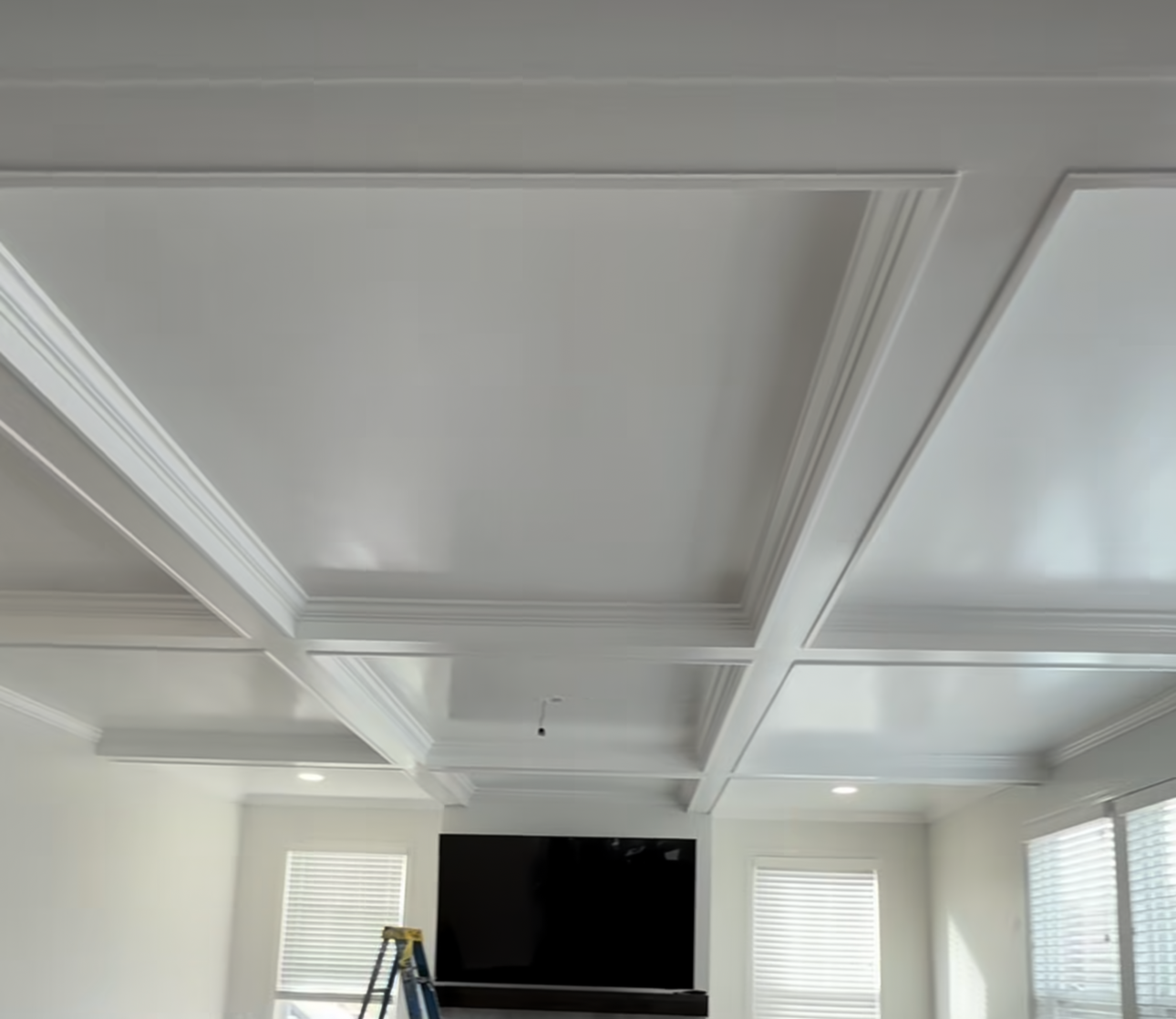
Most renovation stories start with a clean plan and end with a clean result. The ones worth telling are the ones where something goes sideways in the middle — and the finished product is better because of it. This coffered ceiling project in Central Indiana is that story.
We opened the ceiling to begin a custom coffered layout and found a water line that the original builder had left improperly secured inside the cavity. Nobody planned for it. Nobody wanted it. But the moment we found it, the job became something more than a standard ceiling upgrade. It became a test of what real craftsmanship looks like when the conditions aren’t perfect — which, if you’ve worked in residential construction long enough, is most of the time.
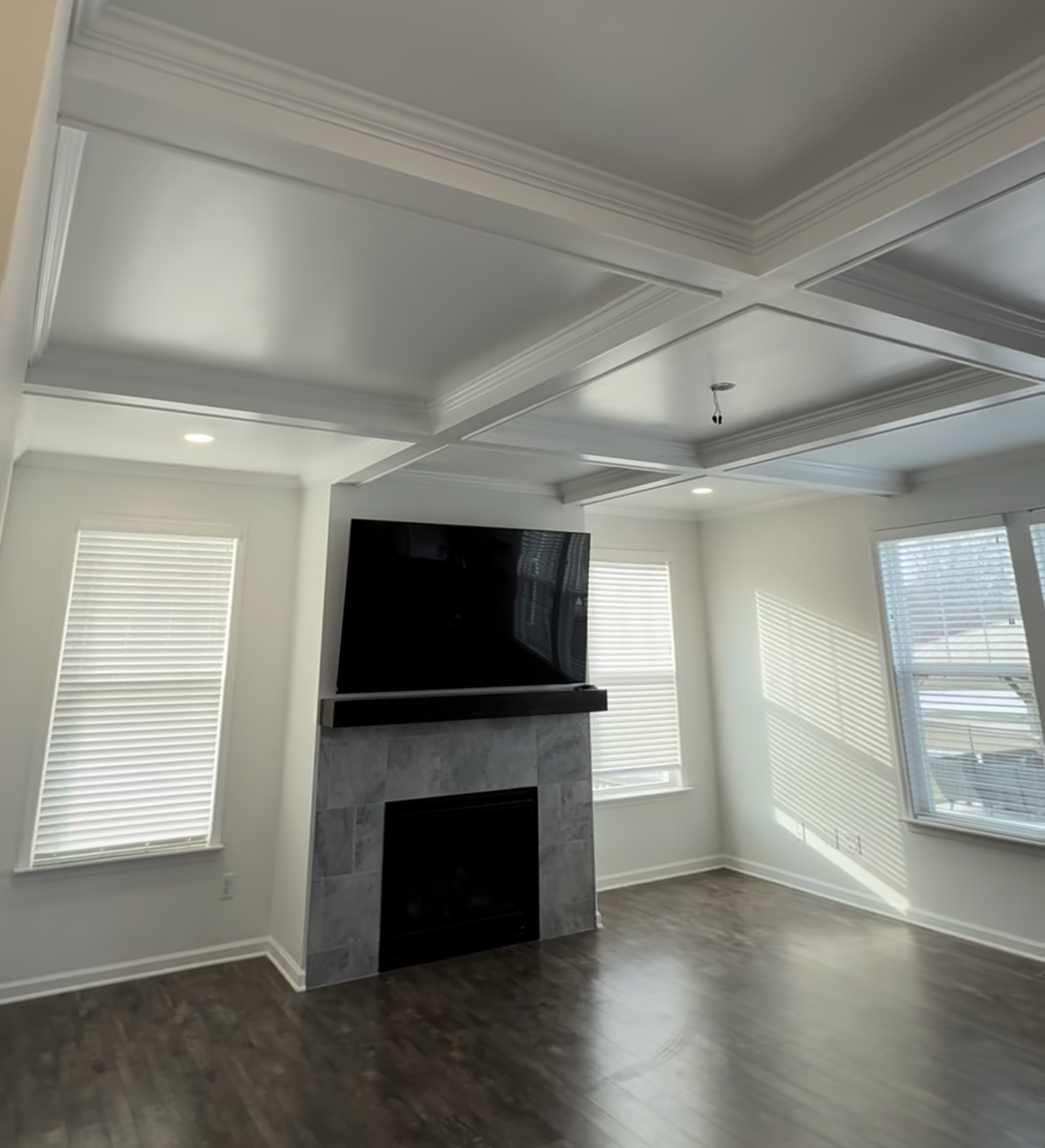
What came out the other side was a coffered ceiling with perfectly smooth drywall, four recessed lights on a dimmable switch, and a finished result that looks like it was part of the original architectural plan. Here’s what that project teaches about custom ceiling work, problem-solving on the job, and what separates experienced trim carpenters from everyone else.
What a Coffered Ceiling Actually Adds to a Home
A coffered ceiling is one of the most architecturally significant upgrades a homeowner can make to an interior space. It takes a flat, featureless overhead surface and turns it into a grid of recessed panels framed by structural-looking beams — giving the room height, dimension, and a sense of architectural history that no paint color or lighting fixture can replicate on its own.
The design originated in classical European architecture, where coffered ceilings appeared in grand public buildings and private estates as a way to reduce the weight of vaulted stone ceilings while adding geometric beauty overhead. Today, the principle is the same even if the materials are different. A well-executed coffered ceiling in a Central Indiana home carries that same sense of permanence and intention — the feeling that a room was designed, not just built.
Design forecasts for 2026 consistently place coffered ceilings among the most-requested architectural upgrades in both new construction and renovation projects, particularly in living rooms, dining rooms, and primary bedrooms where homeowners want a genuine focal point overhead. The reason is straightforward: a coffered ceiling changes the perceived scale of a room. The grid of beams creates visual structure that makes a standard eight or nine-foot ceiling feel taller and more considered. It adds shadow lines that shift with the light throughout the day, keeping the room visually interesting in a way that a flat ceiling never can.
1. A Coffered Ceiling Project Reveals What’s Inside Your Walls — and That’s a Good Thing
One of the realities of residential construction that most homeowners don’t think about until a renovation project forces the conversation: what’s behind your walls and above your ceilings is not always what it should be. Builders work under time and budget pressure, and the work inside the cavities — the plumbing, the electrical, the blocking — doesn’t always get the same attention as the surfaces that show.
When we opened this ceiling to begin the coffered layout, we found a water line that hadn’t been properly secured by the original builder. Left in place, that line would have continued to shift over time — and eventually, it would have caused a problem that showed up not as a minor repair but as a water-damaged ceiling, compromised drywall, or worse. Finding it during a planned renovation meant we could address it correctly, at the right time, without emergency pricing or collateral damage to finished surfaces.
This is one of the most underappreciated arguments for investing in custom millwork and architectural carpentry early in a home’s life: the process of opening walls and ceilings for planned upgrades routinely uncovers issues that would otherwise stay hidden until they became genuinely costly problems. A coffered ceiling installation requires enough ceiling access that a skilled carpenter will see what’s there. That visibility is valuable. It turns a renovation project into a whole-home health check, whether you planned for that or not.
The water line was reworked properly, secured where it belonged, and the ceiling was ready to receive the coffered layout on a schedule that kept the project moving. The homeowner gained a beautiful coffered ceiling and the peace of mind that comes from knowing the space above it was handled correctly.
2. Re-Drywalling to a Smooth Finish Is Harder Than It Looks — and Worth Every Hour
Once the water line was addressed and the ceiling was fully opened to accommodate both the coffered layout and the new recessed lighting, every open section required fresh drywall. That meant taping, mudding, sanding, and finishing a ceiling that needed to meet the same standard as the coffered grid being installed around it.
Smooth drywall ceilings are among the most unforgiving surfaces in residential construction. Every imperfection shows. Every tool mark, every ridge at a tape joint, every slight variation in the mud application catches raking light and announces itself. Achieving a truly smooth finish on a ceiling — especially one that’s being integrated with a coffered grid where the transitions between panels and beams need to be crisp and exact — requires patience, skill, and a willingness to sand and re-coat until the surface is genuinely right, not just close enough.
The decision to eliminate the textured ceiling completely was the right one for this project. Textured ceilings were a builder-grade standard for decades, primarily because texture hides imperfections — which means they were always a workaround rather than a design choice. A smooth ceiling paired with a coffered grid reads as intentional and architectural. A textured surface beneath the same coffered layout would have undercut the entire effect, making the beams and panels look like an add-on rather than a feature that belongs to the room.
The smooth finish also interacts with light differently. When the recessed lights are dimmed in the evening and the ceiling is casting a soft, even glow across the coffered panels and the recessed fields between them, a smooth surface reflects that light cleanly. Texture scatters it. The choice to do the work correctly — to re-drywall every section and take the time to finish it properly — is part of what makes the completed coffered ceiling look like it was there from the start.
3. Recessed Lighting Transforms a Coffered Ceiling From Architectural to Architectural and Functional
A coffered ceiling on its own is a structural and aesthetic achievement. A coffered ceiling paired with thoughtfully placed recessed lighting on a dimmable switch is a room that works differently at every hour of the day. These are two separate values, and combining them in a single project is one of the most effective upgrades a homeowner can make to a living space.
The four recessed lights added to this project were positioned within the coffered layout to work with the geometry of the grid, not against it. Recessed cans placed without regard for the coffered structure can end up looking accidental — as if someone added lighting after the fact without considering where the beams would fall. When the lighting plan is developed alongside the ceiling layout, the fixtures land in positions that feel considered and proportional, with each light serving a specific zone of the room below.
The dimmable switch adds a layer of control that transforms how the room functions throughout the day. Full brightness for tasks and gatherings, mid-range for casual evenings, low for atmosphere — the same room reads completely differently depending on where the dimmer sits. When the coffered ceiling is lit at a lower level, the shadow lines in the grid deepen and the room takes on a warmth and intimacy that flat, fully lit ceilings simply cannot produce. That kind of flexibility is what separates a well-designed room from one that’s just finished.
Interior designers consistently identify recessed lighting integrated into coffered ceiling grids as one of the most high-value lighting upgrades available in residential construction, precisely because it serves both the architectural and the practical goals of the space at the same time. You’re not choosing between beauty and function. You’re getting both from the same installation.
4. The Best Coffered Ceiling Is the One That Looks Like It Was Always There
This is the standard every coffered ceiling project at Radford Woodworks is measured against: when the work is done and the room is put back together, does it look like a renovation was completed, or does it look like the home was always this way? Those are two very different outcomes, and the difference between them comes down to the quality of the planning, the precision of the installation, and the care taken in every finishing step.
A coffered ceiling that looks like it was always there requires consistent beam profiles that match the existing trim language of the room. It requires corners that are tight and square, not caulked over to hide gaps. It requires transitions between the coffered grid and the surrounding walls that feel like part of the architecture, not like a frame added to an existing surface. And it requires a paint finish — on both the smooth field panels and the beams — that reads as one unified surface rather than multiple materials painted separately.
This project delivered all of that. The coffered layout was designed to work within the specific dimensions of the room, with beam spacing that produces proportional panels across the full ceiling. The recessed lights are centered within their respective panels, reinforcing the geometric logic of the grid. The smooth white finish runs continuously across every surface — beams, panels, and the surrounding ceiling — so the eye reads the entire overhead plane as a single, considered composition.
When the homeowner walked in at the end of the project, the reaction wasn’t about the water line that was found or the re-drywalling that was required or the extra days the project needed to be done correctly. The reaction was to the room itself — which looked intentional, elevated, and original to the home. That’s the only outcome worth building toward.
What Happens When You Choose the Right Team for the Job
Custom ceiling work requires a specific kind of experience that not every contractor brings to the table. Coffered ceilings in particular demand an understanding of geometry, proportion, framing, and finish work that spans multiple trades. When an unexpected complication arises mid-project — as it did here — the difference between a team that handles it and a team that doesn’t comes down to experience, honesty, and the willingness to do what’s right rather than what’s convenient.
At Radford Woodworks, we’ve built enough ceilings across Central Indiana to know that surprises happen. Water lines get found. Framing doesn’t land where the plan assumed it would. Existing drywall turns out to be in worse shape than it looked from below. These aren’t reasons to cut corners or revise the scope downward. They’re opportunities to do the job more completely than originally planned — and to leave a homeowner with a result that’s better than what they first envisioned.
The coffered ceiling at the center of this project is that result. It started as a planned upgrade and became a full ceiling renovation that addressed a hidden structural issue, added functional recessed lighting, eliminated a dated textured surface, and produced a finished product that looks like it was drawn into the original architectural plans. That’s not a lucky outcome. That’s what happens when a team takes the complications seriously and sees them through.
It’s Not How You Start — It’s How You Finish
Every project has a plan. Not every project follows it. The homes we’re most proud of at Radford Woodworks are often the ones where something unexpected changed the course of the job — because those are the projects that required genuine problem-solving, real craftsmanship, and the kind of commitment to quality that doesn’t waver when the conditions get complicated.
A coffered ceiling, properly designed and precisely installed, is one of the most lasting architectural upgrades a Central Indiana homeowner can invest in. When that coffered ceiling comes with smooth drywall, integrated recessed lighting, and a finish that looks like it was always part of the home — built through a process that also caught and corrected a hidden plumbing issue — the value of the work goes well beyond what shows on the surface.
If you have a room that deserves better than what’s overhead, we’d love to talk through what’s possible. Reach out to us at (317) 739-8555 or visit radfordwoodworks.com/contact — we’re always happy to walk through a space with you and talk about what a custom ceiling could look like in your home.