
There’s a surface in your home that every designer, architect, and trim carpenter will tell you is the most underestimated canvas in any room. It’s not the floors. It’s not the walls. It’s the ceiling. For years, homeowners and even builders treated it as an afterthought—a flat white surface that existed simply to hold the light fixtures. But in 2026, that idea is officially over.
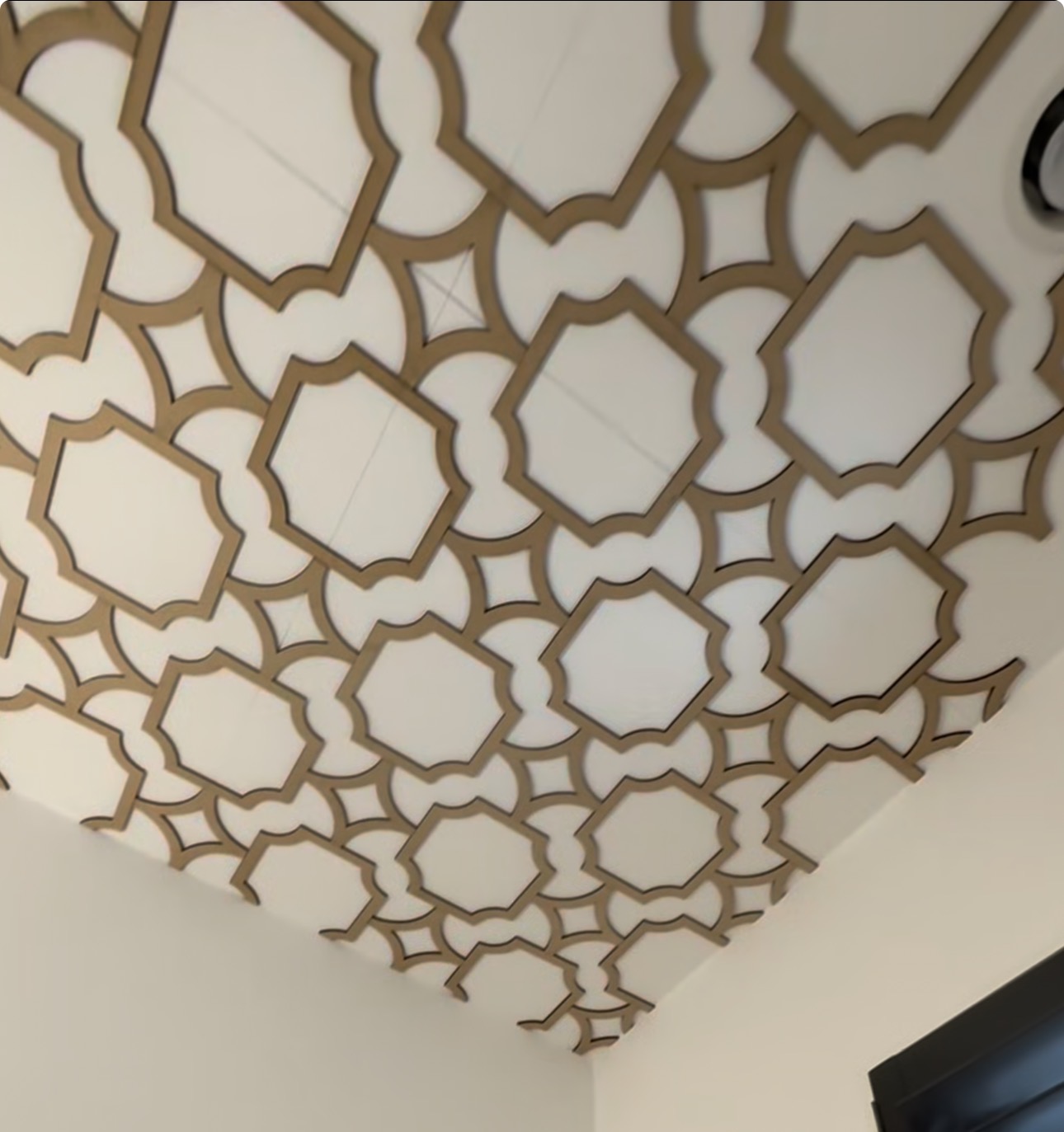
Interior design forecasts confirm that statement ceilings have become the defining trend of the year, with designers calling the ceiling the “fifth wall” and treating it with the same creative intention once reserved for floors and cabinetry. At Radford Woodworks, we’ve believed this for a long time. The custom fretwork ceiling we recently completed in a beautiful Holiday Farms home in Central Indiana is proof of what’s possible when you stop ignoring what’s above you and start treating it as the architectural opportunity it truly is.
What Custom Ceilings Actually Do for a Room
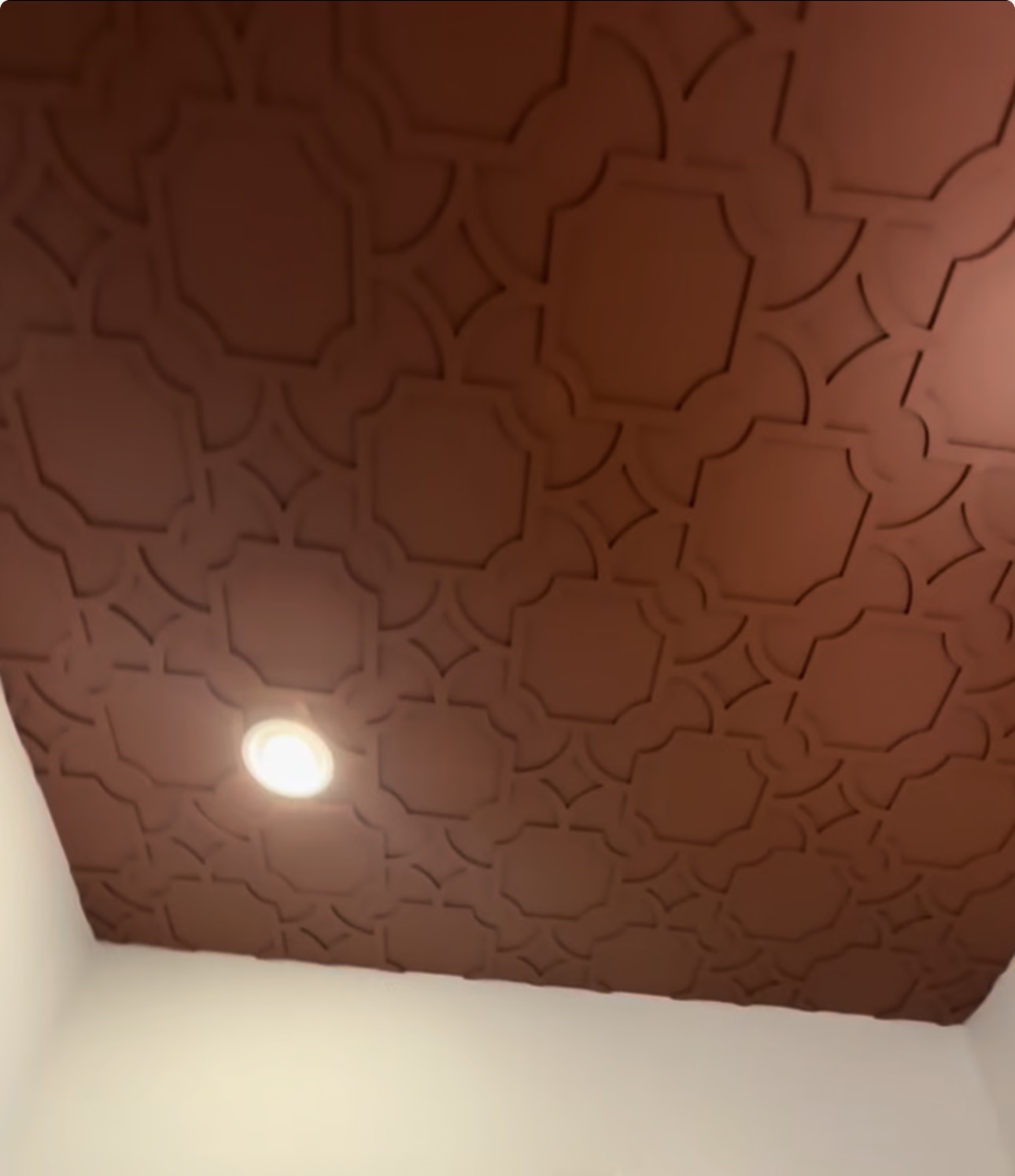
Most homeowners underestimate how much a ceiling shapes the entire mood of a space. Walk into a room with flat, painted drywall overhead and your eye stops at the walls. Walk into a room with a custom fretwork ceiling and something completely different happens—your eye travels upward, the room feels taller, more considered, and more alive. That’s not a coincidence. That’s design working exactly the way it should.
Designers across the country are reporting that bold ceiling treatments—from geometric fretwork to coffered panels, wood planks, and decorative moldings—are now among the most requested upgrades in both new construction and home renovation projects. The reason is straightforward: a well-executed ceiling treatment adds architectural richness that paint and furniture alone can never achieve. It creates the feeling that a home was truly designed from top to bottom, not just assembled room by room.
At the Holiday Farms project, our team installed a custom fretwork ceiling in the bathroom that transformed what could have been a standard finishing detail into something genuinely extraordinary. Every panel was measured, cut, and installed to form a precise geometric pattern that turned the ceiling into architectural artwork. When the light hits the fretwork at different times of day, the shadows shift and the pattern takes on new dimension. That kind of detail is what makes a custom home feel custom.
1. Fretwork Ceilings Bring Geometric Depth That No Other Treatment Can Match
Fretwork is one of the oldest decorative arts in the world, but its current application in ceiling design feels entirely fresh and of the moment. Geometric fretwork patterns—clean lattice designs, intersecting lines, and repeating motifs—are among the most-requested ceiling treatments in 2026, particularly in rooms where architectural drama is the goal. The appeal is its ability to add substantial visual complexity without overwhelming the space.
What makes fretwork so well-suited to ceilings is the way it plays with light. As natural and artificial light filters through or reflects off the cutouts and raised surfaces, it creates a shifting pattern of shadow and illumination that changes throughout the day. In a bathroom, where light conditions vary from morning routines to evening wind-downs, that interaction between the ceiling treatment and the light source keeps the room feeling alive and considered.
The installation at Holiday Farms required precision at every step. Custom fretwork isn’t a product you order and mount in an afternoon. Each panel needs to be measured against the specific dimensions of the room, cut to account for plumbing fixtures, lighting placements, and ceiling irregularities, and then installed so that the geometric pattern reads as one continuous, uninterrupted design from edge to edge. That level of craft is what separates architectural millwork from decorative shortcuts.
Fretwork also works across multiple design styles, which is one reason it has held its appeal across centuries. For a bathroom with a transitional or traditional character, fretwork adds a timeless quality that feels earned rather than applied. For a more modern space, geometric fretwork with clean, linear cutouts gives the room an edge that other ceiling treatments can’t quite replicate.
2. Board and Batten Walls Create the Texture That Ties a Room Together
If a custom ceiling is the architectural centerpiece of a room, the walls need to earn their place in the design as well. That’s why we paired the fretwork ceiling at Holiday Farms with custom board and batten on the walls. Board and batten is one of the most enduring and well-loved wall treatments in residential carpentry, and its continued popularity in 2026 is a reflection of its ability to add texture, depth, and a sense of craftsmanship to any interior.
The premise is elegantly simple: vertical boards mounted to the wall with narrower strips covering the seams create a surface that’s inherently more interesting than smooth drywall. When painted, board and batten adds shadow lines that shift with the light, giving the wall a three-dimensional quality that rewards close inspection. In a bathroom, where surfaces are often limited by vanities, mirrors, and fixtures, board and batten works particularly well because it can be scaled to fit between architectural elements without losing its visual impact.
What makes board and batten especially effective in this project is the way it connects the walls to the ceiling. The vertical rhythm of the batten strips carries the eye upward toward the fretwork, creating a visual conversation between the two surfaces. The room doesn’t feel like a ceiling treatment that was added to a plain space. It feels like a complete design, where every surface was considered as part of a single composition. That sense of cohesion is the hallmark of high-end trim work, and it’s something that only comes from working with a carpenter who understands how details relate to each other.
3. The Right Millwork Makes a Bathroom Feel Like a Spa
Bathrooms have undergone a dramatic shift in how homeowners and designers think about them. The 2026 bathroom is no longer just a functional utility space—it’s a room that’s expected to deliver the atmosphere of a personal retreat. That shift has pushed demand for high-end finishes, architectural millwork, and custom details that create a sense of luxury without requiring a full gut renovation.
Custom ceiling treatments and wall millwork are central to that transformation. When a bathroom features a fretwork ceiling, board and batten walls, and carefully selected trim profiles, the overall effect is closer to a boutique hotel suite than a standard residential bathroom. That’s not an accident—it’s the result of treating the space with the same design intention that goes into a great living room or kitchen.
According to Sweeten’s 2026 bathroom data, homeowners are increasingly investing in details that add layered visual interest: textured surfaces, considered lighting, and architectural elements that make the room feel designed rather than finished. Custom millwork delivers exactly that. It gives the bathroom a sense of permanence and quality that tile alone can’t achieve, and it creates a backdrop that makes every other design element in the room look more considered.
At Radford Woodworks, our approach to bathroom millwork always starts with the relationship between the surfaces. The ceiling, the walls, and the trim profiles all need to speak the same design language. When they do, the result is a space that feels effortlessly put together—a room where nothing feels out of place and everything feels intentional.
4. Custom Ceilings Add Real Architectural Value in Central Indiana Homes
The case for custom ceiling treatments isn’t just aesthetic. There’s a measurable return on investment when homes feature architectural millwork that buyers and appraisers can see and touch. In Central Indiana, where the new construction market continues to attract homeowners who value craftsmanship and quality finishes, custom millwork has become one of the most reliable ways to differentiate a home from its neighbors and command attention in the market.
Holiday Farms is a community where homes are built to a high standard, and the homeowners there understand the value of details that go beyond the builder’s base package. A fretwork ceiling and board and batten walls aren’t things you see in every home. They communicate a level of investment and care that buyers recognize immediately, even if they can’t always articulate why the space feels so much more refined than comparable homes.
Architectural Depot’s 2026 design trend report notes that architectural millwork—including custom ceiling treatments, detailed wainscoting, and board and batten applications—is among the top value-adding interior upgrades homeowners are pursuing this year. The reason is that millwork is one of the few upgrades that both increases a home’s perceived value and genuinely improves the day-to-day experience of living in the space. It doesn’t just photograph well. It feels better to live with.
5. Precision Installation Is What Separates Good Millwork from Great Millwork
A beautiful design on paper only becomes a beautiful room when the installation is executed with precision. Custom fretwork ceilings in particular demand a level of technical accuracy that leaves very little margin for error. The geometric pattern only works when every panel lines up correctly, every joint is tight, and the overall installation reads as one continuous surface rather than a collection of individual pieces.
That precision starts with measurement and planning. Before a single panel is cut, we map the ceiling against the room’s existing dimensions, account for any irregularities in the framing or drywall, and determine exactly how the pattern will land at each edge and corner. This planning stage is what prevents the kinds of visual misalignments that can undermine even the most beautiful material.
Installation requires the same focus. Each panel needs to be secured without visible fasteners, finished without visible seams, and painted or stained so that the transitions between panels disappear entirely. The result should look like the ceiling was always this way—like the home was built with this detail from the very beginning. When trim carpentry is executed at that level, it doesn’t announce itself. It simply makes the room feel better than it did before, and the craftsmanship reveals itself gradually to anyone who takes the time to look.
This is exactly the standard we hold ourselves to at Radford Woodworks on every project, whether it’s a single bathroom in Holiday Farms or a full new construction build across Central Indiana. The details matter. The fit matters. The finish matters. And the difference between adequate and excellent is always felt, even when it isn’t always named.
When One Surface Changes Everything
The most powerful thing about a custom ceiling is how much work it does for the entire room. It reframes the walls, gives the lighting new purpose, and shifts the whole atmosphere from ordinary to architectural. When that ceiling is paired with board and batten walls and precise trim detail—the way it was at Holiday Farms—the entire bathroom becomes something worth pausing to take in.
Details like these are what make a custom home feel genuinely custom. Not the square footage. Not the appliance packages. The craft. The thoughtfulness. The willingness to look up, look at every surface in a room, and ask what it could be if it were done right.
If you have a space in your home that you walk past every day without thinking much about it, it might be exactly the right room for a treatment that changes how the whole house feels. We’re happy to talk through what’s possible in your home. Give us a call at (317) 739-8555 or fill out our contact form at radfordwoodworks.com/contact — we’d love to hear what you have in mind.