
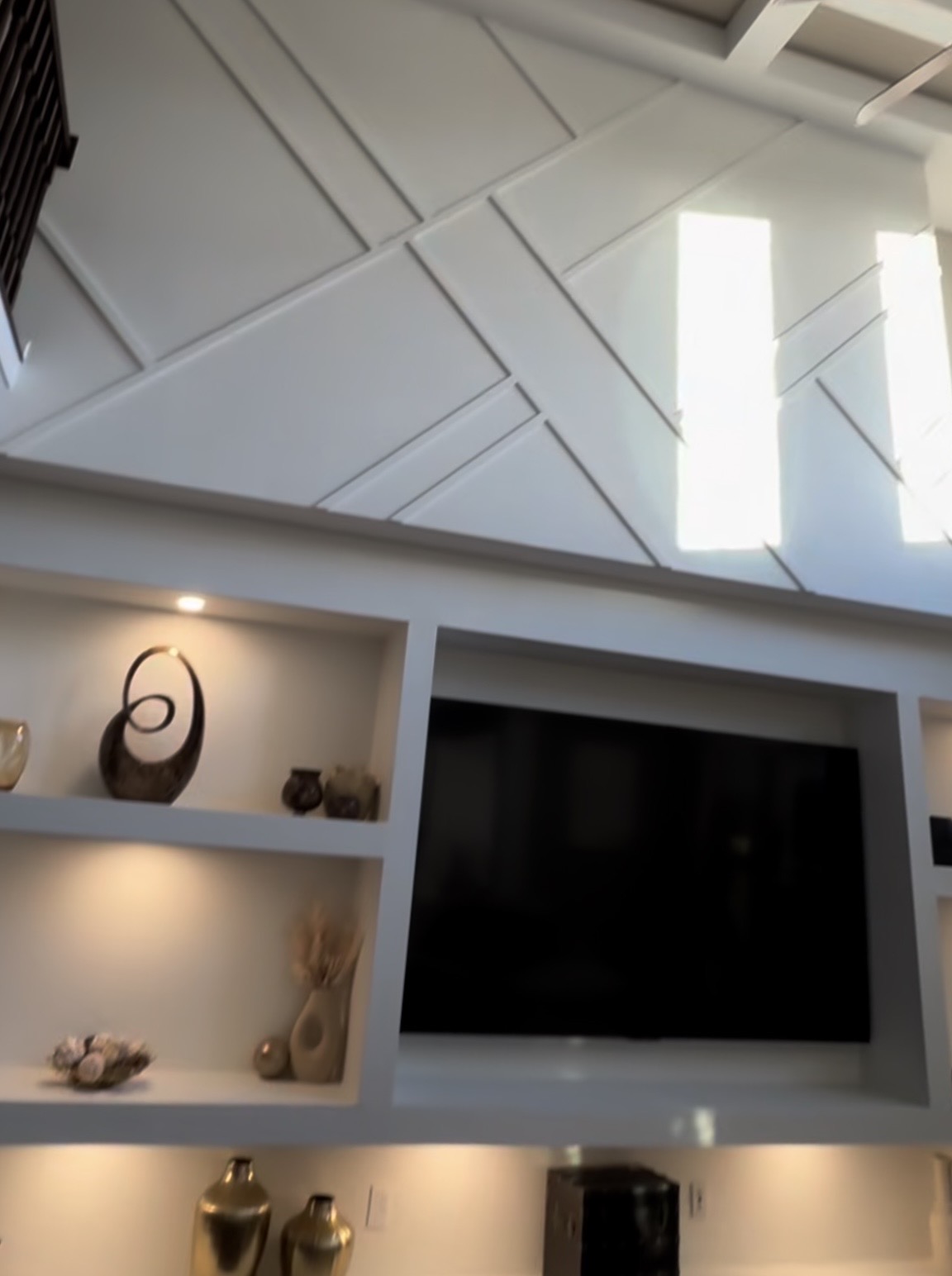
A blank wall is an unrealized opportunity. It sits there, unfinished, waiting for something more. Whether it’s an empty living room expanse, an awkward corner, or a wall that’s just… there—it represents potential that most homeowners recognize but don’t know how to unlock.
In 2026, design professionals and homeowners alike are embracing a new mindset: if a wall exists, it should work. It should serve a purpose. It should speak. Custom wall transformation has moved from luxury indulgence to standard expectation, and the results are nothing short of remarkable.
When a trusted client recently approached Radford Woodworks about a blank wall in their home, we didn’t see an empty surface. We saw the opportunity to build something intentional—something designed with purpose from the framing stage through the final brushstroke of paint. The result was a full transformation: custom framework, electrical planning for recessed LED lighting, shelving built for both function and form, meticulous drywall finishing, and architectural details that make the space feel less like a room and more like a curated experience.
This is what it means to build “from studs out.”
The Case for Intentional Wall Design
Design trends come and go, but intentionality is here to stay. According to 2026 design forecasts, homeowners are increasingly prioritizing spaces that feel purposefully planned rather than randomly decorated. A generic accent wall with paint? That’s 2024. A custom wall feature with architectural integrity? That’s 2026.
Built-in shelving and feature walls have become the proving ground for this intentionality. When done right, they accomplish something simple yet powerful: they make a room feel finished, curated, and thoughtfully designed. They transform a space from “builder-grade home” to “this homeowner cares about every detail.”
The impact goes beyond aesthetics. Storage and organization upgrades rank among the highest return-on-investment home improvements, with professional shelving and custom storage solutions recovering approximately 83% of their cost at resale. More importantly, they address a universal problem: homes never have enough storage, and badly managed storage makes spaces feel cluttered and chaotic.
Custom wall solutions solve both the aesthetic and functional challenge simultaneously.
From Framing to Finishing: The “From Studs Out” Approach
Saying a wall was built “from studs out” might seem like a contractor’s throwaway phrase, but it actually means something specific and substantial. It means the entire wall—from its structural skeleton to its final finished surface—was designed and built with intention.
Here’s what that process involves:
Custom Framework Planning: Rather than simply framing a standard wall, the structural design is planned around the specific purpose. Where will shelves bear weight? How deep do they need to be? Where can adjustable shelving work, and where do fixed shelves provide structural integrity? These questions shape the underlying framing before a single sheet of drywall goes up.
Electrical Integration: Modern shelving isn’t just storage—it’s a display platform, and display requires light. Professional wall design incorporates electrical planning for recessed LED lighting, cove lighting that creates ambient glow, or accent lights that highlight specific items. This isn’t an afterthought; it’s planned before drywall goes up. Running conduit, positioning outlets, and planning fixture placement becomes part of the structural design.
Drywall Finishing Excellence: Once framing and electrical are complete, drywall finishing becomes the bridge between rough construction and polished design. Professional drywall work requires multiple layers of joint compound, careful sanding, and an understanding of how different light conditions expose imperfections. A Level 4 or Level 5 finish (the highest professional standard) creates a smooth, uniform surface that photographs beautifully and feels completely finished—not the rough, imperfect surface that screams “builder-grade.”
Custom Shelving Installation: Once the wall is perfectly finished, custom shelving is installed with precision and care. The shelves themselves might feature adjustable systems for flexibility, fixed shelves for structural integrity, or a combination of both. Hardware is selected and positioned thoughtfully. Everything aligns, levels, and reads as intentional rather than improvised.
Finishing Touches: Paint colors are selected to complement the shelving, lighting is positioned to create the desired ambiance, and the entire feature is designed as a complete, integrated system rather than isolated components.
The LED Lighting Element: Invisible Infrastructure, Visible Impact
One element that separates professional custom walls from DIY attempts is lighting strategy. Professional LED lighting in shelving and feature walls serves multiple purposes: it showcases items on the shelves, it creates architectural interest through cove and accent lighting, and it adjusts to different moods and occasions through dimmable, controllable systems.
Recessed LED cove lighting, positioned along the perimeter of shelving, creates indirect illumination that highlights the wall’s architecture without harsh shadows. Wall wash lighting creates an even, distributed glow. Wall grazer lighting—positioned closer to the wall surface—creates more dramatic shadow effects that accentuate texture and depth. These aren’t decorative afterthoughts; they’re design tools that transform how the space reads in both daylight and evening settings.
The electrical planning for this requires foresight. Conduit needs to be run. Dimmer switches need to be positioned thoughtfully. Power sources need to be calculated for load capacity. This is why professional design matters—it’s not just about what you see, but the invisible infrastructure that makes the visible design work seamlessly.
Precision Craftsmanship: Why Proportions and Details Matter
When every element of a wall—from framing to finishing to shelving to lighting—is designed together rather than layered on afterward, the result is architectural cohesion. The proportions work. The sightlines align. The details support the overall design rather than fighting against it.
A shelf that’s slightly too deep will visually overwhelm a room. A shelf spacing that’s off by an inch will make the wall feel unbalanced. Lighting that’s positioned poorly will cast shadows that make shelves harder to use. Paint that’s not finished to perfection will read as unpolished. These details, individually small, collectively determine whether a wall feels like thoughtful design or accidental decoration.
This is why repeat clients trust their walls to experienced builders. Your first project might be a test—a single wall, a specific space. But if that wall reads as intentional, proportioned correctly, lit beautifully, and finished flawlessly, the impulse is to invest in more. To design more walls. To transform more spaces.
The Shift in 2026: From Accent Walls to Architectural Features
Accent walls—those single colored walls meant to create visual pop—are falling out of favor. In their place, designers and homeowners are embracing architectural features: walls that function, walls that solve problems, walls that make statements through their design rather than their color choice.
A custom wall with integrated shelving, professional lighting, and precision finishing accomplishes something a painted accent wall never could. It demonstrates investment. It shows intention. It becomes a focal point not through shock value, but through quality.
This shift aligns with a broader 2026 design trend: the move toward spaces that feel curated rather than decorated. Curated spaces feel like someone thought about them, planned them, invested in them. Decorated spaces feel like someone grabbed some elements and hoped they worked. The difference is visible, immediate, and significant.
Real Impact: What a Custom Wall Transformation Delivers
Beyond the visual and functional improvements, custom wall features deliver measurable returns:
Storage Solution: In a market where homes perpetually lack storage, built-in shelving directly addresses a universal pain point. It makes spaces feel more organized, functional, and livable.
Resale Value: Professional custom shelving and feature walls are among the improvements that homeowners and real estate agents notice and value. They signal quality and intentionality to potential buyers.
Daily Living Quality: The space simply functions better. Items are organized. Light is pleasant. The wall works for you rather than against you.
Emotional Connection: A well-designed custom wall creates a space worth spending time in. A room with a beautiful, functional focal point feels finished and cared for.
Planning Your Own Custom Wall Transformation
If you’re considering a wall transformation, the planning conversation is where everything begins. Questions worth asking:
- What’s the wall’s primary purpose? Display? Storage? A combination?
- What items or collections would this wall showcase?
- How does natural light hit this wall at different times of day?
- What architectural style does your home represent, and how should the wall align with it?
- Is this a fixed design, or do you want flexibility for future changes?
- What’s the budget range, and where should resources be prioritized?
These questions shape the design process from the beginning. They ensure that when your wall goes from studs to finished surface, every decision serves the overall vision rather than happening randomly.
Ready to Transform Your Next Blank Wall
Every wall is a blank canvas waiting for intention. Whether you’re drawn to built-in shelving, architectural features, integrated lighting, or a complete custom wall transformation, the 2026 approach is clear: plan with purpose, execute with precision, and design spaces that feel finished rather than empty.
If your home has been waiting for its moment—if there’s a blank wall that’s been nagging you for attention, a space that could be more functional, or a room that would benefit from an architectural focal point—the conversation is worth having.
Thinking about upgrading a wall in your home? Let’s start the conversation. Reach out to Radford Woodworks with your vision, your space, and your questions. We’ll walk you through the design process, explore what’s possible, and help you understand how to transform blank into bold.