
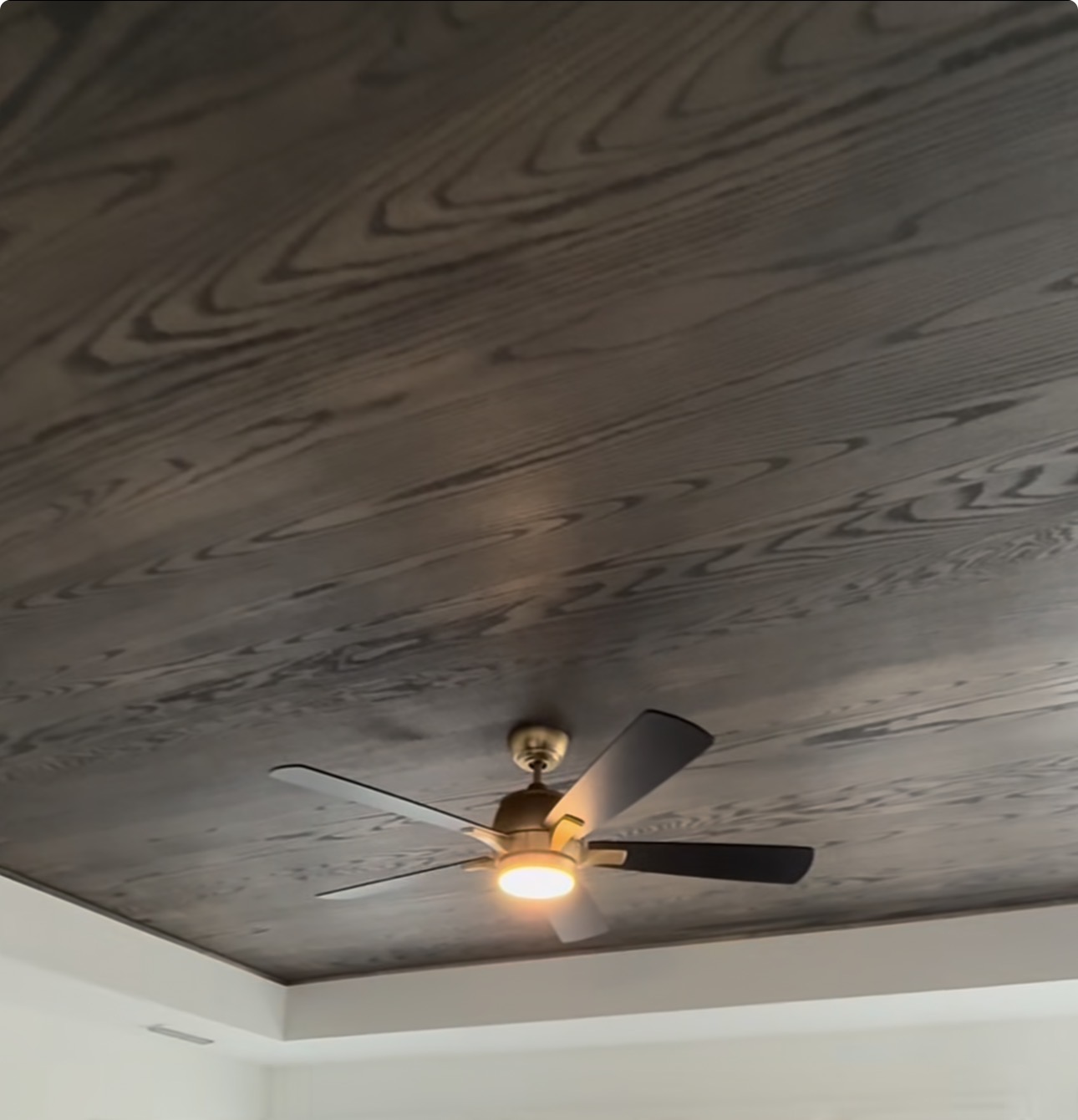
There are rooms you walk into and immediately feel something, even before your eyes have fully registered what they’re seeing. The air feels warmer. The space feels more settled. The room feels like it was built with actual intention, not just framed, drywalled, and painted and called done. That feeling—the one that arrives before you can name it—almost always traces back to one overlooked surface. The ceiling.
This red oak ceiling, built from locally sourced Indiana lumber, installed tight and finished with a hand-matched stain, is exactly that kind of detail. It doesn’t announce itself loudly. It sets the entire tone of the room without asking for your attention. And once you do look up, you understand exactly why the space felt so different the moment you stepped inside.
At Radford Woodworks, this is the kind of work that drives everything we do. Not just building things that look good in a photograph, but building things that change how a room feels to live in. Here’s why a custom red oak ceiling does that better than almost any other architectural detail you can add to a home.
What a Red Oak Ceiling Actually Does to a Space
A red oak ceiling is not a cosmetic upgrade. It is a foundational shift in the way a room reads architecturally. When natural wood planks replace flat white drywall overhead, the ceiling stops being a blank plane and becomes an active part of the design. The grain pattern draws the eye. The texture catches the light. The warmth of the wood radiates downward and wraps the entire room in a tone that no paint color can fully replicate.
Red oak in particular brings a set of characteristics that make it one of the most requested materials for custom ceiling treatments. Its grain is pronounced but not overwhelming—it has enough personality to be genuinely interesting without dominating the room. The natural undertones run warm, sitting in the amber and honey range, which means the ceiling adds warmth to the space even before a stain is applied. With a hand-matched stain, those tones deepen and unify across the boards so that the ceiling reads as one continuous surface rather than a collection of individual planks.
The dark, rich stain finish on this project deepens the red oak’s natural grain and gives the ceiling a grounded, dramatic quality that feels both modern and timeless. Against the clean white walls and trim below, the contrast is striking without being jarring. The ceiling becomes the feature without competing with anything beneath it. That’s the mark of a decision made with confidence—when the boldest element in the room still allows everything else to breathe.
1. Locally Sourced Lumber Makes a Red Oak Ceiling More Than a Design Choice
There’s a growing conversation in design and construction circles about where materials come from and what it means to build with intention. Locally sourced lumber is at the center of that conversation, and for good reason. When you build a red oak ceiling from lumber harvested in Indiana, you’re working with wood that has acclimated to the region’s climate, which matters more than most homeowners realize.
Wood moves. It expands in humidity and contracts when the air dries out. Indiana’s seasonal range is significant—humid summers that push moisture into every surface, followed by dry winters that pull it back out. Wood that was grown and milled locally has already adjusted to that cycle. It’s more stable in an Indiana home than wood shipped in from a region with a completely different climate profile. That stability shows up in the installation: tighter joints, boards that stay flat, and a finished surface that holds its fit across seasons and years.
There’s also something worth naming about what locally sourced lumber means for the character of the finished product. The grain patterns, the color variations, the texture of the boards—these are all shaped by the specific conditions of the land where the trees grew. A red oak ceiling built from Indiana lumber doesn’t look like something ordered from a catalog. It looks like it belongs here, which is precisely the quality that makes custom millwork feel irreplaceable.
Sourcing locally also supports the network of mills, suppliers, and craftspeople in Central Indiana that make this kind of work possible. Every board we select reflects a standard of quality that we control from the start—not lumber that’s been sitting in a regional distribution center waiting for a bulk order, but material we’ve evaluated and chosen specifically for the project at hand.
2. Precision Installation Is What Turns Good Material Into a Great Red Oak Ceiling
The quality of a red oak ceiling lives in the installation. Beautiful lumber that’s poorly installed will never deliver the result a homeowner deserves. Boards that aren’t properly acclimated before installation will shift after the fact, opening gaps at the joints. Fasteners placed without care leave a surface that looks assembled rather than crafted. Stain applied without attention to how each board’s grain responds to the finish produces a ceiling that reads inconsistent—some boards darker, some lighter, no coherent story across the surface.
Proper installation of wood ceiling planks requires accounting for the ceiling framing, joist spacing, and the weight distribution of the boards across the structure. It requires planning the layout so that the boards start and end in positions that honor the geometry of the room, not just the most convenient point for the installer. It requires a stain process that’s applied and matched across the boards as a unified whole, not board by board in isolation.[lumberplus]
The result of that attention is what you see in this project. The boards sit tight against each other with no visible gaps. The stain moves consistently across the entire ceiling, with the grain showing through as a pattern rather than a patchwork. The fan sits centered in the field of wood, its dark blades and brass fixture complementing the stain rather than competing with it. Every decision, from lumber selection to the final finish coat, points toward the same result: a red oak ceiling that feels like it was always meant to be there.
That’s the standard every Radford Woodworks installation is held to. Not adequate. Not close enough. Built correctly from the first board to the last.
3. The Right Stain Finish Makes or Breaks a Wood Ceiling
Stain selection for a red oak ceiling is one of the most consequential decisions in the entire project. Red oak’s open grain structure means it absorbs stain differently than close-grained species. It takes color well and shows depth, but the same open pores that create that richness can also expose inconsistencies if the stain isn’t applied and matched with care. A hand-matched stain process—where the finish is developed specifically for the boards in the project rather than pulled straight from a standard color card—produces results that a mass-production approach simply can’t match.
The stain on this ceiling sits in the darker, charcoal-adjacent range that gives the room its immediate sense of drama and grounded sophistication. This direction aligns with one of the most compelling finish trends in custom woodworking for 2026: the move away from uniform, expected tones toward finishes that interact with the wood’s natural character and produce a result that reads warm, aged, and considered. The dark stain on this red oak ceiling doesn’t obscure the grain—it amplifies it, pulling the swirling patterns and natural variations in the wood to the surface so that the ceiling becomes visually layered in a way that flat paint never could be
When light from the ceiling fan moves across the surface throughout the day, the stain and grain interact to produce a shifting effect—the ceiling looks slightly different in morning light than it does in the evening. That quality is one of the hallmarks of natural wood in an interior space, and it’s one of the reasons homeowners who invest in a custom wood ceiling consistently describe the result as something that continues to reward them long after the project is finished.
4. A Custom Red Oak Ceiling Works Harder Than Any Other Single Detail in a Room
This is the point that most homeowners don’t fully appreciate until they’re living with a custom ceiling: no other single architectural detail does as much work for a room as what happens overhead. Floors get covered by furniture and rugs. Walls get interrupted by doors, windows, art, and built-ins. But the ceiling sits unobstructed above the entire room, influencing every square foot of the space below it.
A red oak ceiling shifts the perceived scale of a room. In a space with a tray ceiling like this one, the wood applied to the recessed plane creates a visual layer that makes the ceiling feel lower in the best possible way—not cramped, but intimate and considered. The white walls and trim around the perimeter keep the room feeling open, while the dark wood overhead grounds it and gives it weight. The result is a room that feels both spacious and contained, which is an architectural balance that’s genuinely difficult to achieve with standard finishes.
Wood plank ceilings are also among the most enduring design choices a homeowner can make. Unlike paint colors or wallpaper, which reflect specific moments in design history, natural hardwood overhead has appeared in beautiful interiors across centuries and continues to feel current without ever feeling trendy. The specific execution changes—the species, the stain, the plank orientation, the ceiling form—but the underlying choice to put natural wood overhead never ages out. That’s a quality worth investing in.
Design forecasts for 2026 confirm that statement ceilings, and wood ceilings specifically, are among the most requested architectural upgrades in both new construction and renovation projects this year. Homeowners who have spent years in spaces where the ceiling was an afterthought are now asking what it would look like if that surface were treated with the same care as every other element in the room. This project answers that question directly. It looks like this. It feels like this. And it changes everything.
The Detail You Feel Before You Notice It

There’s a kind of craftsmanship that doesn’t ask to be admired. It simply makes a room better and trusts that the people who live in it will understand the difference, even if they never think to articulate it. A custom red oak ceiling, built from locally sourced Indiana lumber and finished with a hand-matched stain, is exactly that kind of detail. It works quietly, completely, and permanently.
At Radford Woodworks, we approach every ceiling project the same way we approach every other surface in a home: with genuine care for the material, respect for the craft, and a commitment to building something that holds its quality for decades. The homes we build in don’t just look different when we’re done—they feel different. That’s the difference between a house that’s finished and a home that’s complete.
If you have a room that’s missing that quality, we’d love to talk through what’s possible. Give us a call at (317) 739-8555 or visit radfordwoodworks.com/contact to start the conversation.