
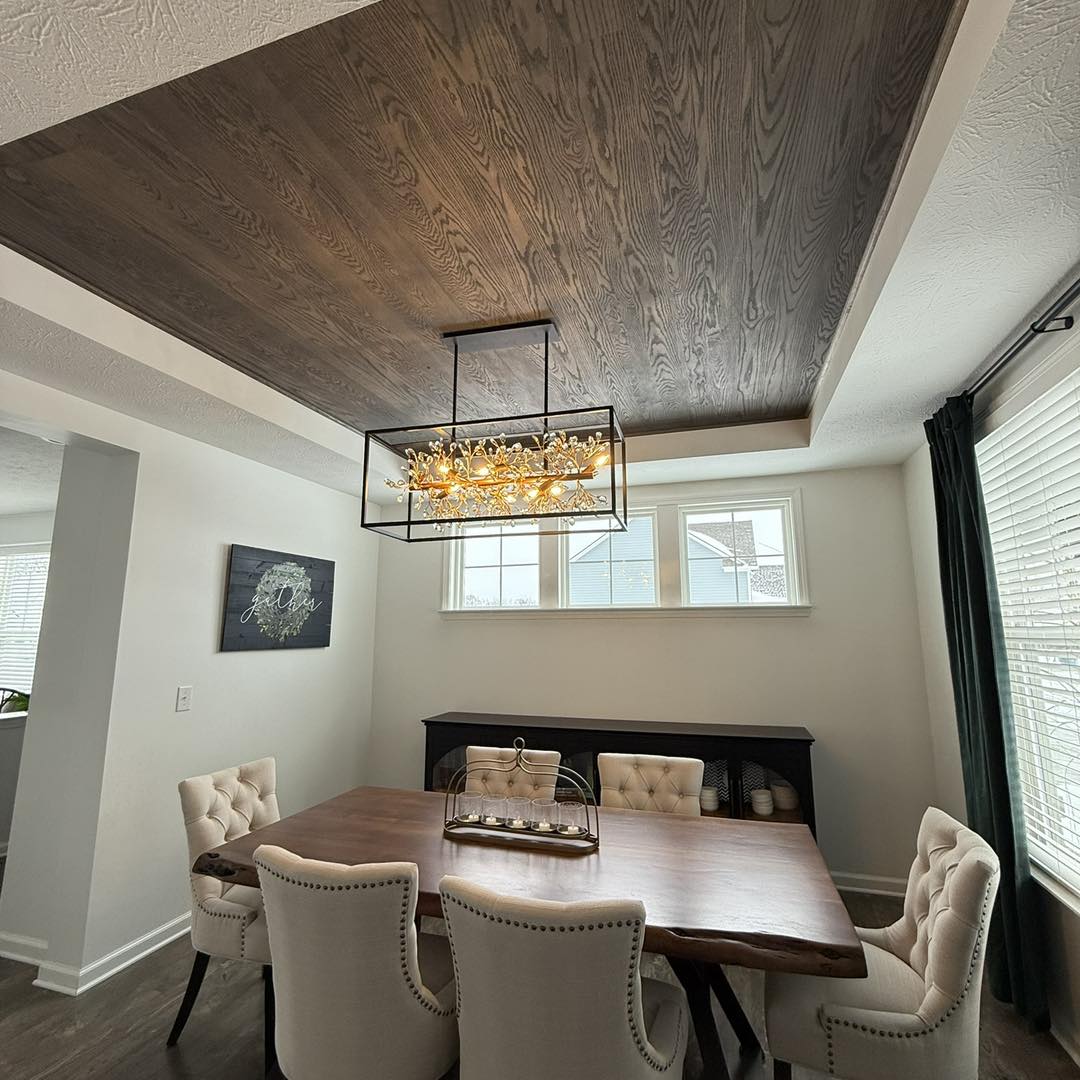
Most homeowners can tell the difference between a room that feels finished and a room that feels designed. The gap between those two things is almost never about square footage, furniture, or paint color. It’s about the surfaces — how they were built, what they were built from, and whether the person who built them cared enough to get every detail right. A tongue-and-groove ceiling, executed at the highest level, lives squarely in that gap. It’s the detail that turns a finished room into a designed one.
The two ceilings we completed last week are built from custom-milled Indiana red oak, installed with no gaps across every board, and stained with a finish that was matched specifically to each home’s existing floors and furnishings. Both look like they’ve always been there. Neither one looks like an upgrade. That’s not an accident — it’s the result of a process that starts long before the first board goes up and continues well after the last coat of finish dries. Here is what that process actually looks like, and why it produces results that stand apart from everything else.
What a Tongue-and-Groove Ceiling Brings to a Room That Other Treatments Cannot
A tongue-and-groove ceiling works differently than other wood ceiling applications because of the way the boards connect. Each board has a protruding tongue along one edge and a corresponding groove along the other. When they fit together correctly, the joint is tight, the surface is flat, and the fasteners are hidden inside the groove — completely out of sight once the ceiling is complete. The result is a wood surface with no exposed nails, no visible gaps, and no interruptions to the grain pattern running across the ceiling.
That structural quality matters as much as the visual one. A ceiling installed with tight tongue-and-groove joinery is a stable surface. The boards support each other across the span rather than relying entirely on the fasteners holding each one to the framing above. When the wood expands and contracts through Indiana’s seasonal humidity swings — humid summers, dry winters — the tongue-and-groove joint manages that movement without producing the gaps or buckling that can appear in other ceiling applications over time.
For the homeowner looking up at the finished ceiling, none of that technical detail is visible. What they see is a continuous field of wood grain that reads as one unified surface, with the shadow lines between the boards providing the only visual rhythm across the plane. In a well-proportioned room, that rhythm is one of the most quietly compelling architectural effects available in residential woodworking. It rewards a long look without demanding one. The ceiling does its work whether you’re conscious of it or not.
1. The Material Standard: Why Custom-Milled Indiana Red Oak Changes Everything
A tongue-and-groove ceiling is only as good as the lumber it’s built from. This is a point that gets passed over quickly in most renovation conversations, but it matters enormously in the finished product. Mass-produced tongue-and-groove boards sourced from a big-box retailer are dimensionally consistent in the way that factory output is consistent: they’re all the same width, the same thickness, and the same everything — which means they’re also all the same in their lack of character.
Custom-milled Indiana red oak is a different material in every way that counts. The grain patterns in red oak grown in this region are pronounced and varied — no two boards run the same. The natural color ranges from warm amber to deeper reddish tones, with individual boards carrying their own distinct character within a shared species profile. When those boards are laid across a ceiling in sequence, the result is a surface that has genuine visual depth. Your eye travels across it and finds something new in every section of the room.
Milling lumber specifically for a project also gives the carpenter control over the dimensions. Standard retail boards are dimensioned for the average application. Custom milling produces boards sized for the specific span, profile, and visual weight of the ceiling being built. That precision shapes how the ceiling reads proportionally in the room — whether the boards feel light and linear or substantial and grounded — and it’s a decision that can only be made when the material is sourced and milled with the project in mind.
Indiana red oak also carries the stability advantage of regional sourcing. Wood grown in the same climate where it will be installed has already adapted to the seasonal moisture range it will experience in service. That means the boards behave predictably after installation, holding their fit across seasons and years without the movement issues that can develop when lumber travels from a different climate zone.
2. The Installation Standard: Tight Joints, Hidden Fasteners, and a Furniture-Grade Surface
A tongue-and-groove ceiling installed at the highest level is indistinguishable from fine furniture in the quality of its surface. That’s not a loose comparison — it’s a specific technical standard. Furniture-grade woodwork means joints that fit without filler, surfaces that are flat and consistent across the entire plane, and a finish that adheres evenly because the wood beneath it was prepared correctly. Applying that standard to a ceiling is harder than applying it to a cabinet or a tabletop, because the ceiling is overhead, the spans are longer, and the lighting conditions that reveal imperfections are uncontrolled.
Getting every board installed tight with no gaps requires that the lumber has been properly acclimated before it goes up — typically several days inside the home so the boards reach equilibrium with the interior’s moisture level before they’re fastened in place. Boards installed before acclimation will move after the fact, and the gaps that open up are nearly impossible to correct without taking the ceiling down. Doing this step correctly at the start protects everything that comes after it.
Fastener placement in tongue-and-groove installation goes through the tongue at an angle — a technique called face-nailing — so that each board’s groove covers the fastener as the next board slides into place. When this is executed precisely, the finished ceiling has no visible nails anywhere across its surface. The boards appear to float together with nothing holding them but their own joinery. That effect is part of what gives a properly installed tongue-and-groove ceiling its furniture-grade quality — it looks assembled by someone who understood that the details no one can name are exactly the ones that make the difference.
Both ceilings completed last week were held to this standard from the first board to the last. Every joint is tight. Every fastener is hidden. Every board sits flat against the framing with no bowing, no high spots, and no inconsistency in the shadow lines between the boards. The surface reads as one piece, not as a collection of individual planks, which is the outcome that distinguishes a ceiling built with genuine craft from one that was merely installed.
3. The Finish Standard: Stain Matched to the Home, Not to a Color Card
The stain on a tongue-and-groove ceiling is where the technical work of installation becomes the visual work of design. It’s the decision that determines whether the ceiling feels like it was added to the home or built for it. And it’s the step where the difference between a standard finish and a custom-matched one is most clearly visible — particularly in a room where the ceiling, the floors, and the furnishings all share the same field of view.
Both of these projects required a stain that was developed specifically to complement the existing floors and furnishings in each home. That process starts with looking at the room as a whole — the tone of the floors, the temperature of the walls, the color weight of the furniture — and identifying a stain direction that brings the ceiling into the same design register without making it a copy of any other surface. The ceiling should feel like it belongs to the room. It should not feel like it matches the floors.
Red oak responds to stain in a way that rewards this kind of attention. Its open grain structure absorbs finish at different rates in different parts of each board, which means the stain reveals the grain rather than covering it. A hand-applied finish allows the person applying it to work with that variation — building color in the areas where the grain is open and lighter, pulling back slightly where the wood is denser, and producing a result that reads as a living surface rather than a painted one.
The finished stain on both ceilings reads consistently across the full span of each room. No board is noticeably lighter or darker than its neighbors. The grain shows through the finish at a depth that gives the ceiling visual texture without visual noise. When the light changes throughout the day, the ceiling reads differently — warmer in the morning, deeper in the evening — in a way that keeps the room feeling alive. That quality is not available from a standard stain applied straight from a manufacturer’s color card. It comes from taking the time to match the finish to the specific wood and the specific room.
Why True Custom Woodwork Looks Original to the Home
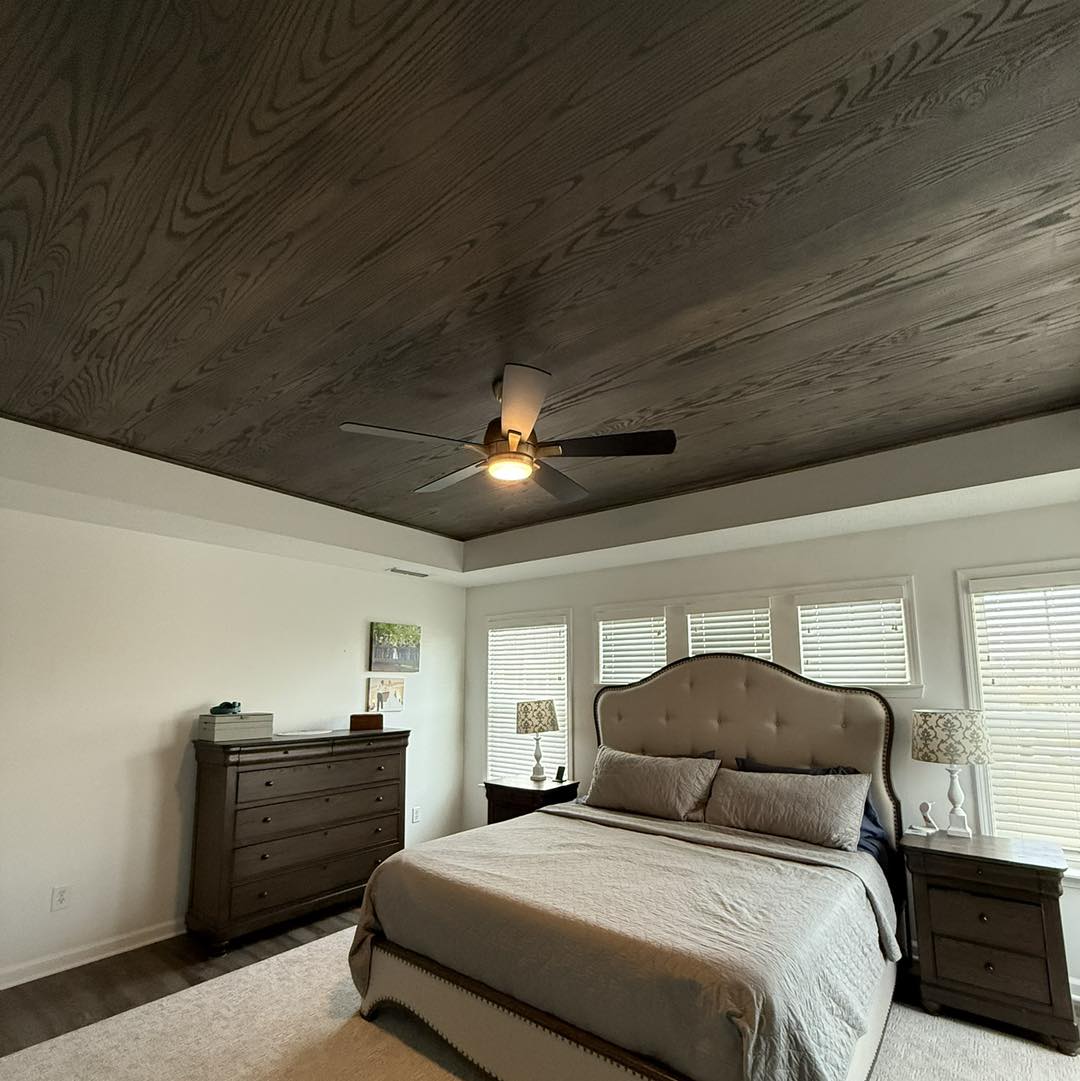
The highest compliment a carpenter can receive about a finished ceiling is that it looks like it was always there. Not “that’s a beautiful ceiling” — though that’s welcome — but the specific observation that the ceiling appears to have been part of the home’s original design. That reaction is what custom-milled material, precise installation, and a thoughtfully matched finish produce when they come together at the right level.
Both ceilings finished last week produce that reaction. The tongue-and-groove red oak reads as part of the architecture, not as an upgrade applied to it. The stain sits in the same tonal family as the floors and furnishings without repeating them. The tight joints and hidden fasteners give the surface the quality of furniture, not of construction. The result is a room that feels designed in a way that is genuinely difficult to explain but immediately apparent to anyone who spends time in it.
At Radford Woodworks, that outcome is the goal on every ceiling project — whether it’s a single bedroom, a great room, or a full new construction build across Central Indiana. The material, the installation, and the finish are three separate opportunities to either honor the craft or cut a corner, and each one shapes the final product in ways that compound. When all three are executed at the highest level, the ceiling stops being a surface and starts being part of the home.
If you have a space where the ceiling deserves more than flat white drywall, we’d love to talk through what’s possible. Give us a call at (317) 739-8555 or visit radfordwoodworks.com/contact — we’re always glad to walk through a space and talk about what a custom tongue-and-groove ceiling could look like in your home.