Every living room has a wall that wants to be more than it is. You walk in, your eye moves toward it naturally, and for a moment, you sense the possibility — the sense that this is the wall the whole room should be built around. In most homes, that moment passes. The wall stays plain. The furniture gets arranged around a TV that floats in the middle of nowhere, and the room never quite finds its center.
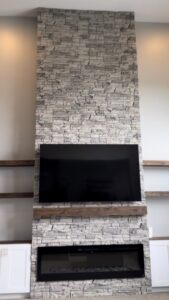
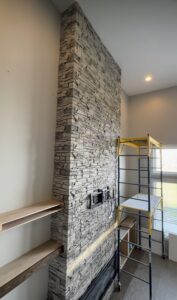
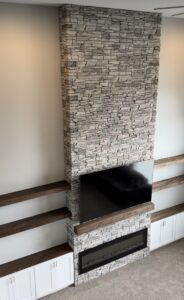
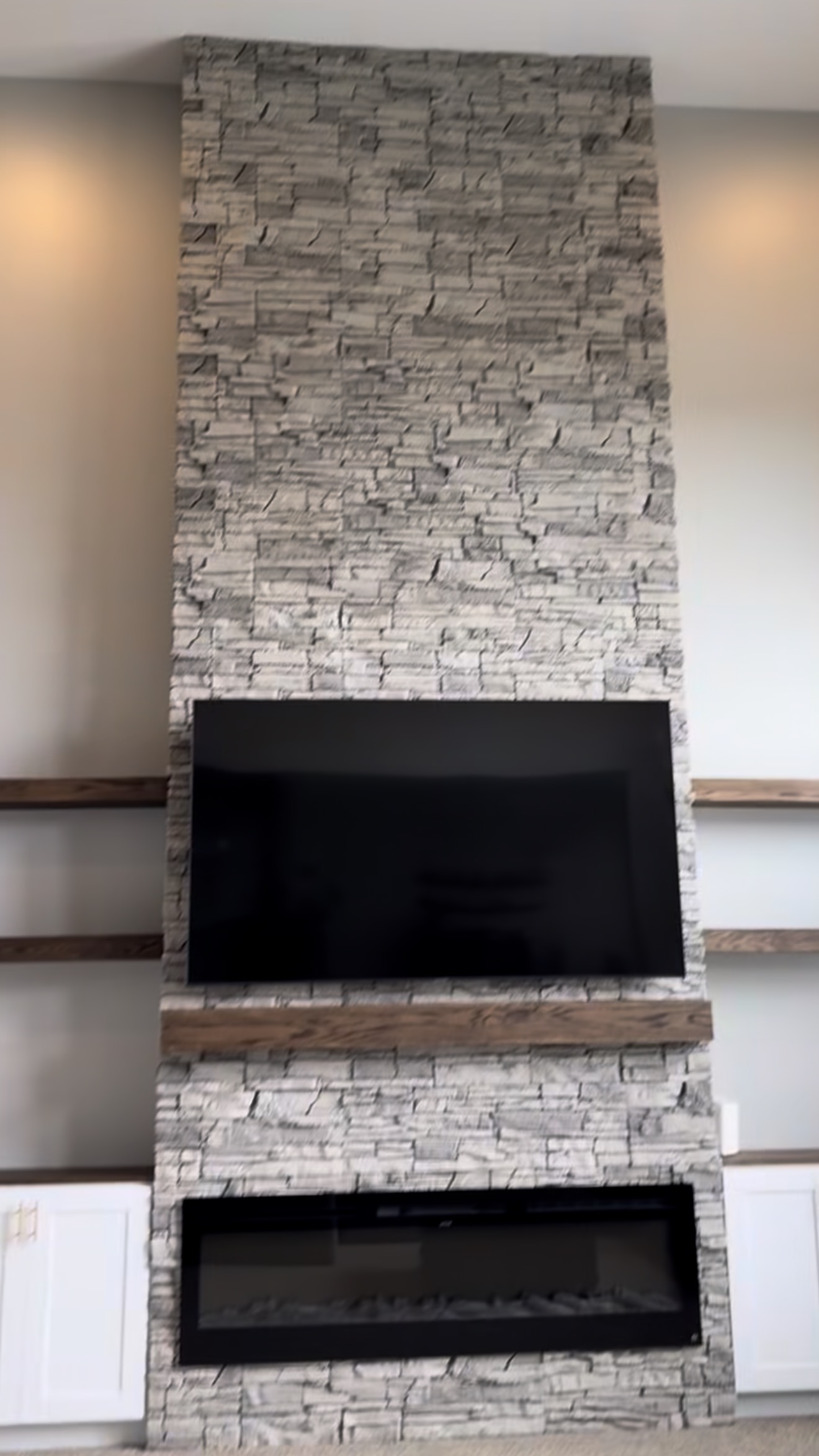
This project found it. The fireplace wall build-out we completed in April 2026 took a blank surface and turned it into an 8-foot full-height focal point that anchors the entire room — stacked stone running from the floor to the ceiling, a Touchstone electric fireplace, custom white shaker cabinets, oak floating shelves, and a mantle and countertops color-matched across every surface. From the scaffolding stage to the final install, this project was about one thing: getting every element to work as a single composition. Here is how it came together, and why the result looks exactly like what a custom fireplace wall should feel like.
Why a Floor-to-Ceiling Fireplace Wall Changes the Entire Room
A fireplace that stops halfway up the wall is a fireplace that misses its opportunity. The surround might be beautiful, the stone might be perfectly laid, and the firebox might be exactly the right width — but if the treatment ends at a chair rail or a mid-wall line and leaves plain drywall above it, the wall reads as incomplete. The eye travels upward and finds nothing. The room’s potential focal point becomes a partial statement instead of a full one.
Floor-to-ceiling fireplace walls have moved from luxury to expected in 2026. Design specialists consistently report that homeowners and their designers are now treating full-height fireplace installations as the standard, not the upgrade, because the vertical continuity of stone, wood, or paneling running from floor to ceiling is what makes a fireplace feel architectural rather than decorative. The difference is immediately felt by anyone who walks into the room. The wall reads as a feature. The fireplace reads as the center of the home.
In this project, the faux stacked stone runs uninterrupted from the baseboard to the ceiling, wrapping the full face of the wall and the side columns of the surround in a single, continuous texture. There’s no transition point, no change in material, no visual interruption at any height. The eye travels from the fireplace insert at the bottom — a horizontal, linear Touchstone electric unit — all the way to the ceiling line eight feet above, and the texture reads consistently across the full span. That continuity is what gives the wall its sense of scale and permanence, and it’s what makes the room feel designed rather than assembled.
1. Faux Stacked Stone — The Texture That Carries the Wall Without Weighing Down the Room
Stacked stone veneer is one of the most enduring material choices for a fireplace wall, and its continued dominance in 2026 residential design reflects something straightforward: it works. The layered texture of horizontally coursed stone creates visual interest that reads from across the room, the irregular surface catches light at multiple angles throughout the day, and the gray and white tones of this particular stone profile sit in the neutral range that accommodates a wide variety of furniture and flooring choices without asserting a specific color story.
What makes faux stacked stone panels particularly well suited to a full-height fireplace wall is their ability to cover large surface areas with consistent texture and color without the weight or structural demands of natural stone. Natural stone at this scale — an 8-foot column rising to the ceiling, with side wraps and a surround that extends from floor to firebox — requires significant structural consideration. Faux stacked stone veneer panels, applied correctly, deliver the same visual result at a fraction of the weight, and the installation can be completed with the precision and alignment that a project at this scale requires.
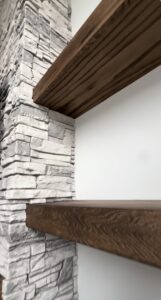
The gray tone of the stone in this project is a deliberate choice that does two things simultaneously. Against the warm, dark oak of the floating shelves and the mantle, the cooler stone creates a contrast that gives each material room to express itself. The oak looks warmer because the stone is cooler. The stone looks more textured because the smooth wood grain sits beside it. Against the white shaker cabinet fronts flanking the fireplace, the stone reads as natural and grounded, preventing the white from feeling clinical or stark. Every material in the composition benefits from every other material around it.
2. Custom White Shaker Cabinets — Storage That Earns Its Place in the Design
A fireplace wall built-in that includes closed storage below the shelving line is a fireplace wall that solves a real problem. Living rooms accumulate things. Remote controls, game controllers, streaming devices, decorative objects that don’t always have a permanent home — all of these need to go somewhere, and in most rooms, they end up visible and scattered. Custom white shaker cabinets flanking a fireplace wall give those things a place to disappear, which is what allows the shelving above and the fireplace itself to remain visually clean.
Shaker cabinet doors are the right choice for this application for reasons that go beyond style preference. The recessed panel and simple rail-and-stile construction of the shaker profile sits comfortably alongside the raw texture of stacked stone without competing with it. A more ornate door profile — raised panel, beaded inset, or decorative overlay — would pull the eye toward the cabinet fronts and away from the fireplace. The shaker door stays in the background by design, performing its function without asserting itself as a feature.
The white finish on the cabinets carries the same tonal value as the lighter elements of the stone, which means the transition from stone to cabinet reads as a natural continuation rather than an interruption. The eye moves from the stone surround to the cabinet fronts without a visual jolt. That continuity across the lower section of the wall is part of what makes the entire built-in feel like a single unit rather than a collection of separate elements — stone here, cabinet there, shelf above.
3. Oak Floating Shelves — Where Warmth Meets the Wall
The oak floating shelves are doing more work in this fireplace wall than their position might suggest. Positioned at two levels on either side of the stacked stone surround, the shelves extend outward from the wall at a depth that gives them the visual weight of furniture rather than trim. The grain of the oak is visible from across the room. The stain, color-matched to the mantle above the firebox, runs consistently across every wood element in the composition — which means the eye reads all of the oak surfaces as one connected material presence within the wall.
Floating shelves in a fireplace built-in serve two purposes, and the best installations honor both. The first is practical: display space for objects, art, and books that benefit from being seen rather than stored. The second is compositional: the shelves break up the vertical run of stone on either side of the surround, adding a horizontal element that contrasts with the strong verticality of the full-height wall. Without the shelves, the side columns of stone would read as uninterrupted vertical planes. With the shelves, those columns have rhythm — the eye follows the stone upward and encounters the shelf as a pause, a landing point, before continuing.
Touchstone’s own 2026 design research confirms that mixed-material fireplace walls — stone with wood accents, warm neutrals paired with natural grain — are among the most requested configurations in electric fireplace installations this year. The reasoning is consistent with what this project delivers: texture and warmth work together. The stone provides the texture. The oak provides the warmth. Together, they produce a wall that feels grounded, natural, and high-end without relying on a single dramatic material statement.
4. Color-Matched Mantle and Countertops — The Detail That Ties Everything Together
The mantle above the Touchstone electric fireplace and the countertops on the cabinet bases are color-matched to the oak floating shelves. This is the decision that prevents the wall from feeling like a collection of individual elements and turns it into a composition with a unified design language. When every wood surface in the wall reads the same tone, the eye groups them together as one material presence — warm, consistent, and intentional — set against the cooler stone and the white cabinet fronts.
Color matching across multiple woodworking elements in a single built-in is harder to execute than it appears. The mantle and the shelving are likely made from different wood species or profile materials, and raw wood accepts stain differently depending on its grain structure, density, and the cut of the board. Getting the same visual tone across all of these surfaces requires testing, adjustment, and an eye for how stain interacts with each specific piece of wood in the project. When it’s done correctly, the result looks effortless. When it’s done incorrectly, the inconsistency announces itself every time someone looks at the wall.
At Radford Woodworks, color matching across a full fireplace built-in is a standard part of our process, not an afterthought. We test the stain on samples from every piece of wood that will appear in the installation before a single coat goes on the finished surface. The goal is always the same: a wall where every element looks like it was designed together from the start, because it was.
Scale, Symmetry, and the Touchstone Electric Fireplace
The Touchstone electric fireplace at the center of this wall is a linear, horizontal unit that stretches across the full width of the stone surround at the base of the wall. Its proportions were a deliberate part of the design decision. Linear electric fireplaces in 2026 are consistently preferred for media walls and full-height built-ins because their wide, low profile anchors the bottom of the wall without competing with the TV above. The firebox reads as a base element — grounding the wall, establishing the center, and creating the visual logic for everything that rises above it.
Electric fireplaces have moved well past the category of trend in residential design. They offer the atmosphere of a traditional fireplace without the installation demands, venting requirements, or ongoing maintenance of a wood or gas unit. At the scale of a full-height media wall, the electric fireplace is often the only practical choice — and the quality of the flame visualization in contemporary units makes the practical choice an aesthetically excellent one as well.
The symmetry of this wall — equal cabinet banks on both sides, shelves at the same heights, the fireplace and TV centered within the stone surround — is the structural principle that holds the entire composition together. Symmetry in a built-in fireplace wall creates a sense of order and permanence that asymmetrical arrangements, however stylish, rarely achieve. The room feels resolved. The wall feels complete. And from the moment you walk in, your eye goes exactly where the design intended — straight to the fireplace at the center of it all.
When Every Element Works Together
The best fireplace walls are the ones where no single element draws attention away from the whole. The stone doesn’t overwhelm the wood. The cabinets don’t upstage the fireplace. The shelves don’t compete with the mantle. Everything holds its place and supports everything around it, and the result is a wall that reads as one complete, considered design.
That’s what this project delivered. From the scaffolding stage — where the stacked stone was installed one course at a time, working up to the ceiling line with consistent alignment and tight joints — through the cabinet installation, the shelf mounting, the stain matching, and the Touchstone fireplace placement, every step was aimed at the same outcome: a fireplace wall that looks like it was always meant to be there. Not a renovation. Not an upgrade. A room that was always this good, finally finished.
For more examples of what custom fireplace walls, trim carpentry, and built-in millwork look like when they’re built to this standard, explore our work at radfordwoodworks.com. If you have a wall in your home that’s ready for this kind of attention, we’d love to hear about it. Reach out to us at (317) 739-8555 or visit radfordwoodworks.com/contact — send us a photo of your space and let’s talk about what’s possible.