Some projects feel like work. Others feel like collaboration — the kind where a client already knows the language you speak, trusts the process, and gives you the freedom to do the work the right way from the start. The slat wall project at The Club at Chatham Hills in Central Indiana was that second kind. This was the second time we’ve worked with this client. They moved from Geist to Chatham Hills and brought Radford Woodworks back in to take their new custom home to the next level. That kind of trust shapes everything about how a project comes together.
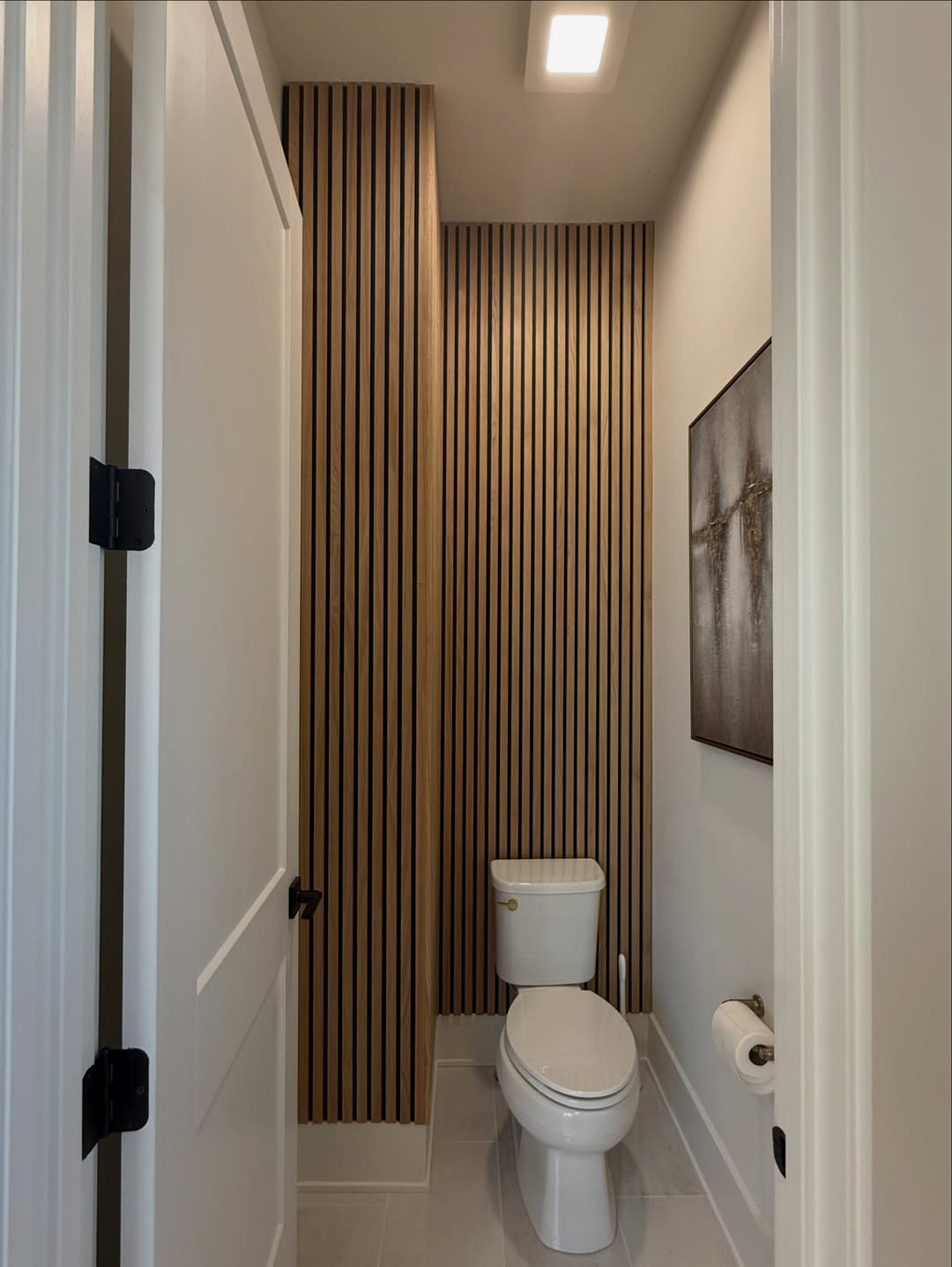
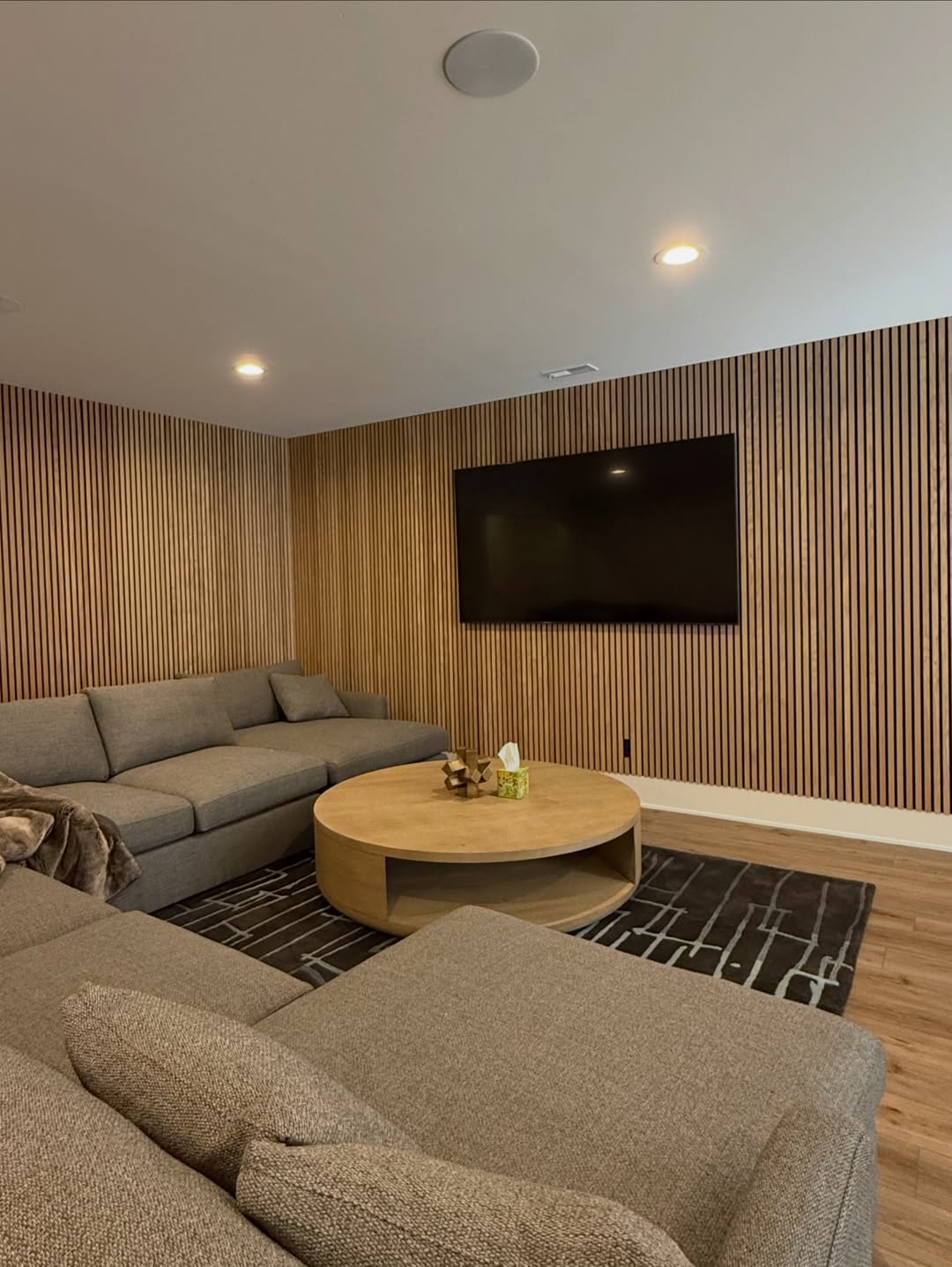
What came out of it was a custom red oak slat wall installation that runs through both the main living space and the primary suite’s washroom — two very different rooms connected by the same design language, the same material, and the same standard of finish. The result is a home where the craftsmanship feels like it was planned from the beginning, not added after the fact. Here is what made this project stand apart, and why a well-executed slat wall is one of the most compelling upgrades available in residential woodworking right now.
What a Slat Wall Actually Does for a Room
A slat wall works on two levels simultaneously — the visual and the functional — and the best installations don’t ask you to choose between them. Vertically oriented wood slats create a surface with strong directional energy: the eye follows the lines upward, the room feels taller, and the wall gains a sense of rhythm and depth that flat drywall or paint simply cannot produce. At the same time, the spaces between the slats, particularly when the slats are backed with felt or installed over a dark backing material, absorb sound reflections that would otherwise bounce off hard surfaces and create the flat, echoey quality that plagues open-plan spaces and finished lower levels.
In 2026, acoustic slat walls have moved well past the category of trend. Design analysts and interior specialists across the industry are describing them as a residential standard — a treatment that addresses both the aesthetic and the acoustic character of a room in a single installation, without requiring the visual clutter of traditional sound-dampening materials. The shift is being driven by homeowners who are increasingly aware of how a room sounds and not just how it looks, particularly in media rooms, living areas, and primary suites where the quality of the acoustic environment directly affects how comfortable the space feels to spend time in.
Red oak brings a specific character to a slat wall that other species don’t replicate. The grain is pronounced and warm, the natural color sits in the amber and honey range, and the wood takes stain in a way that reveals its character rather than covering it. When those qualities are combined with the vertical rhythm of a slat installation, the wall becomes a surface that rewards close attention while reading beautifully from across the room. It’s not a generic product. It’s a material with a point of view.
1. Design Consistency Across Two Rooms Makes the Home Feel Whole
The decision to carry the red oak slat wall from the main living space into the primary suite’s washroom is the most significant design choice in this project. It would have been straightforward to treat each room separately — a slat wall in the media room, a different treatment in the bathroom — and in many homes, that’s exactly what happens. Each room gets its own look, and the house ends up feeling like a collection of separate design decisions rather than a single, cohesive home.
Repeating the same material, the same profile, and the same finish across two rooms in different parts of the house does something fundamentally different. It creates a design language that moves through the home with intention. When you walk from the main living space into the primary suite and see the same red oak slat wall appear again, the experience is not one of repetition — it’s one of recognition. The home has a visual identity, and every space participates in it.
For a client who moved from one custom home to another and brought the same team back to do the work, this kind of design continuity is exactly what the project called for. They already understood the value of craftsmanship that feels considered. They wanted a home where every room felt like part of the same story. The slat wall, installed consistently across both spaces, delivers that quality in a way that no single-room treatment could.
Interior design reports for 2026 consistently identify material repetition across spaces — using the same wood species, the same finish profile, or the same architectural detail in multiple rooms — as one of the strongest signals of a genuinely designed home versus one that was finished room by room without an overarching plan. At Chatham Hills, the red oak slat wall is that signal. It tells you, from the moment you see it, that someone thought about this home as a whole.
2. The Acoustic Performance of a Custom Slat Wall Goes Beyond What Paint Can Do
The washroom installation illustrates one of the most compelling arguments for a slat wall in a small, hard-surfaced space: acoustics. Bathrooms are acoustically challenging rooms. Tile floors, glass, and hard wall finishes create a highly reflective environment where sound bounces from surface to surface without anything to slow it down. The result is a space that feels louder than it should, with a hollow, reverberant quality that no amount of styling can fix.
Installing a slat wall in the washroom changes that acoustic character directly. The wood slats introduce a textured, absorptive surface that breaks up sound reflections at the point where they originate — the wall itself. The spaces between the slats, and any backing material behind them, trap sound energy rather than reflecting it back into the room. The result is a quieter, warmer-sounding space that feels more like a private retreat and less like a tiled utility room.
Research from acoustic design specialists confirms that wood slat panels with felt backing are among the most effective wall-mounted acoustic treatments available for residential interiors, reducing reverberation meaningfully in small, hard-surfaced rooms without the visual weight of foam panels or the cost of full acoustic treatment. At the scale of a washroom, the acoustic benefit is immediately perceptible — the room simply feels different, and the slat wall is the reason.
The visual benefit in the washroom context is just as significant. A small bathroom with flat white walls on every surface can feel sterile and closed-in. The slat wall behind the toilet gives the room a focal point, adds vertical energy that makes the space feel taller, and introduces a material warmth that softens the hard surfaces around it. The room goes from functional to designed without any structural changes — just the right wall treatment in the right location.
3. The Detail Work — Matching Outlet Covers — Is What Defines True Custom
There is a specific category of craftsmanship that most people don’t consciously notice but that everyone feels. It’s the category of details that exist not because they’re visible but because their absence would be. Replacing the standard white outlet covers and outlets with a finish that matched the overall design language of the slat wall installation belongs squarely in that category.
Standard white outlets on a warm-toned wood slat wall would have read as an interruption — a reminder that a contractor installed something and then moved on without thinking about what came next. The decision to swap them out for a cohesive finish option removed that interruption entirely. The outlets sit in the wall without drawing attention to themselves. They do their job invisibly, which is exactly what every utilitarian element in a well-designed room should do.
This is a detail that costs relatively little in time and materials. But the effect it has on the finished room is disproportionate to its cost. It’s the difference between a room that looks like it was designed and a room that looks like it was almost designed. The slat wall itself is the main event, but the outlet covers are part of what makes the main event feel complete. When every element in a room — including the ones that are purely functional — is treated with the same level of care as the feature wall, the result is a space where nothing feels like an afterthought.
Custom woodwork at the highest level is full of decisions like this one. Most of them go unnoticed. All of them matter. At Radford Woodworks, we take that category of detail seriously on every project, because the standard of craftsmanship we hold ourselves to doesn’t have exceptions for the small things.
4. A Returning Client Is the Most Honest Review a Carpenter Can Receive
A homeowner hiring the same carpentry team for their second home is a more meaningful endorsement than any five-star review. It means the first project didn’t just look good when it was finished — it held up, it continued to deliver, and when the time came to build again, there was no question about who to call. That kind of trust is built one detail at a time, and it reflects a relationship that goes beyond the transaction of a single job.
The client who moved from Geist to Chatham Hills and brought Radford Woodworks back to their new home understood something that the best clients always understand: the quality of the craftsman matters as much as the quality of the design. A great design executed by the wrong team produces a mediocre result. A considered design executed by a team that genuinely cares about the work produces a home that continues to reward the investment for years.
At The Club at Chatham Hills, the slat wall installation is the continuation of a working relationship built on exactly that standard. The red oak was sourced and selected with the same care as the first project. The installation was executed with the same commitment to tight joints, clean lines, and considered details. And the design language — consistent across both rooms, cohesive with the rest of the home — reflects the kind of thinking that only comes from a team that approaches every project as a collaboration rather than a contract.
For homeowners in Central Indiana who are building new or upgrading existing spaces, that’s the standard worth looking for. Not just a carpenter who can build a slat wall, but one who understands why every detail in that wall matters — and who will still be the right choice when you move to your next home.
When the Wall Does More Than Decorate
The red oak slat wall at Chatham Hills is beautiful. That’s the first thing anyone who walks into either room will notice. But beneath that first impression is a wall that’s managing acoustics, creating spatial energy, carrying a design language across two rooms, and doing all of it with a level of material and installation quality that will hold for decades. The wall doesn’t just decorate the room. It improves it — functionally, acoustically, and architecturally — in ways that compound over time.
That’s the standard a truly custom slat wall is capable of meeting when it’s built from the right material, installed with precision, and finished with the kind of attention that extends to every outlet cover and every backing detail. It’s also the standard that brings a client back for their second project and keeps them coming back after that.
If you’re ready to bring that level of craftsmanship to your home, we’d love to be part of the process. Reach out to us at (317) 739-8555 or visit radfordwoodworks.com/contact — we’re always glad to talk through what a custom slat wall could look like in your space.