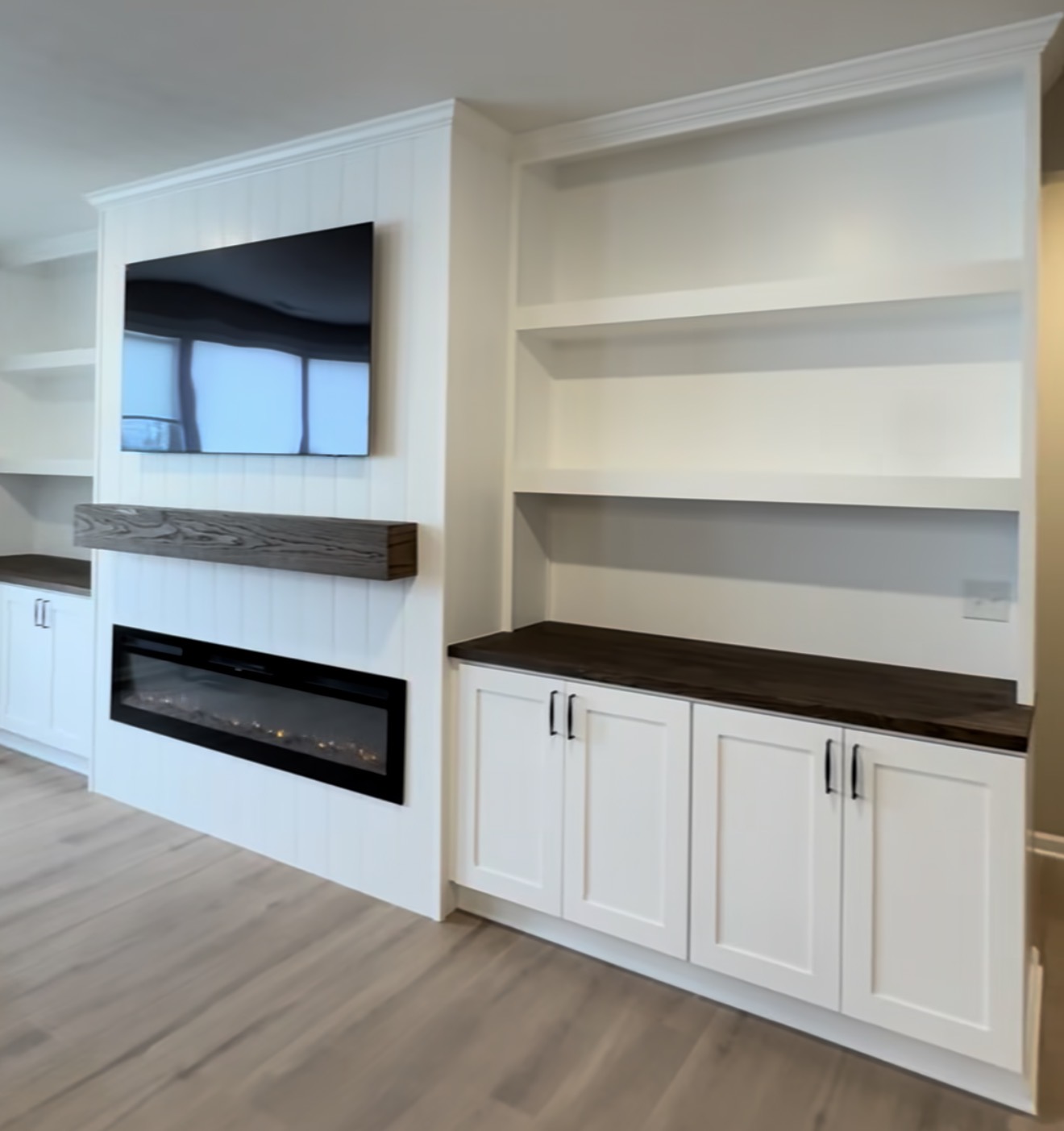
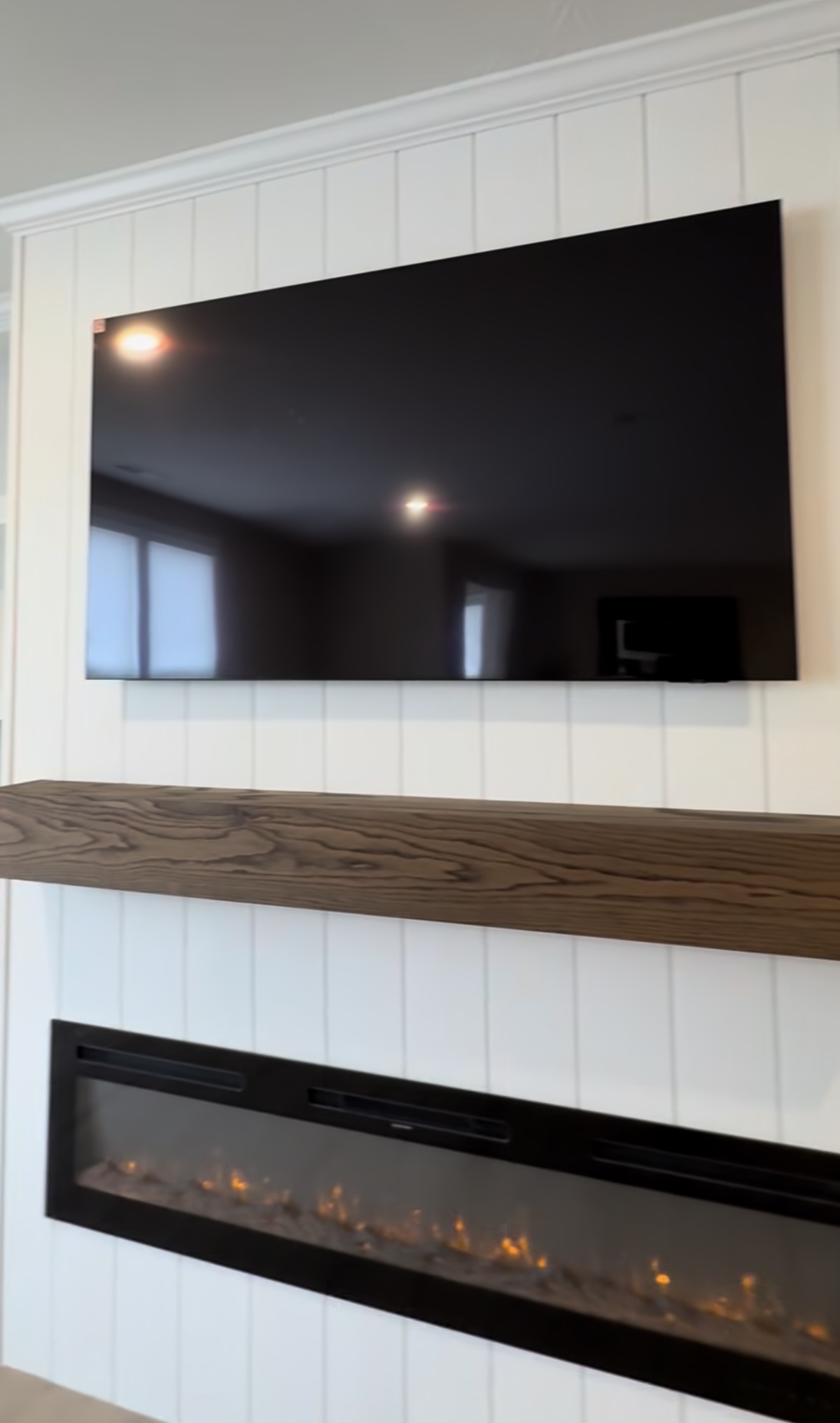
The finished product always gets the attention. The photographs go up, the room looks polished, and it’s easy to focus on what you can see — the clean lines of the shiplap, the grain of the wood mantle, the warm glow of the electric fireplace beneath it. What those photographs don’t show is everything that happened before the final coat dried: the decisions that changed the design, the reasoning behind the materials, the spray equipment delivering a finish that most homeowners have never seen applied in their own home.
At Radford Woodworks, process is not a backstage detail. It’s the reason the final product looks the way it does. This fireplace build-out in Westfield, Indiana tells that story better than most. The finished wall is beautiful — vertical white shiplap, a dark stained oak mantle, deep storage cabinets, and an electric fireplace framed inside a clean, built-in surround. But what made the result possible was a series of deliberate choices made before a single board went up, and a commitment to execution that shows up in every surface of the finished room.
Why the Design Changed — and Why That’s a Sign of a Good Carpenter
The original plan for this fireplace build-out called for a shallower profile. The wall would have a standard built-in depth that worked architecturally and looked right from across the room. Then the scope of the project changed: Grandma was relocating to Indianapolis and moving into the home. A shallower build-out would look the same but perform very differently — and in a home with a growing family and more people sharing the space, performance matters.
The decision was made to increase the depth of the build-out to create real, usable storage inside the lower cabinets. Not display space. Not decorative shelving. Storage deep enough to tuck away toys, keep the room organized, and give the family a clean surface to come home to every day. That’s a practical consideration, but it’s also a design one. A room that functions well feels better to be in than a room that looks good but creates friction every time someone needs to put something away.
Adjusting the depth of a fireplace built-in mid-design is not a small change. It affects the framing, the cabinet box dimensions, the countertop depth, the relationship between the built-in and the surrounding walls, and the way the whole unit reads proportionally in the room. A carpenter who understands the full scope of the project can make that adjustment without losing the integrity of the design. A carpenter who is working from a fixed plan and not truly engaged with the client’s life cannot. The willingness to adapt the plan — not because the original was wrong, but because the client’s needs became clearer — is what separates a good working relationship from a transactional one.
What Vertical Shiplap Does That Horizontal Cannot
Shiplap has earned its place as one of the most requested wall treatments in residential carpentry, and it shows no sign of slowing down in 2026. But the direction of the boards — horizontal versus vertical — changes the entire character of the wall, and in a fireplace build-out, that direction choice matters more than most homeowners realize.
Vertical shiplap installed on a fireplace surround draws the eye upward along the length of the boards rather than across them. In a new construction home with standard ceiling heights, that vertical movement makes the room feel taller than it is. The lines of the shiplap reinforce the height of the built-in, which gives the fireplace wall a more substantial, architectural presence. A horizontal installation on the same wall would have the opposite effect — the eye travels across the board lines, which is a natural direction for reading and resting, but it doesn’t add the vertical energy that makes a fireplace wall feel like a genuine focal point.
The white finish on the vertical shiplap in this project is a deliberate contrast to the dark stained oak of the mantle, the countertop, and the fireplace shelf below. That contrast is where the design does its best work. The white shiplap recedes visually, creating a clean backdrop that allows the wood tones to read clearly and warmly in front of it. Without the contrast, the dark wood would sit on a wall that competes with it for attention. With the white shiplap behind it, the oak mantle stands forward and the fireplace below it becomes the natural resting point for the eye.
This pairing of vertical shiplap with more traditional elements — dark stained wood, shaker cabinet doors, crown molding at the top of the built-in — reflects a broader direction in new construction design for 2026. The strongest fireplace walls this year are the ones that don’t commit entirely to one aesthetic. They use modern elements like clean lines and linear fireboxes alongside traditional elements like real wood grain and classic millwork profiles. The result is a room that feels current without feeling temporary — a design built for how people actually live, not for how a trend photo looks.
Real Built-In Storage — The Feature That Changes How a Family Lives
The deep storage cabinets in this fireplace build-out are one of the most important design elements in the finished room, even though they’re the least visible. Behind those shaker cabinet doors is the organizational infrastructure for everything the living room needs to function as a shared family space — toys, games, media components, seasonal items, and all of the other things that accumulate in a room where multiple people spend time every day.
Integrated storage around a fireplace is one of the most consistently requested features in residential built-in work, and 2026 design forecasts confirm that functional storage within fireplace surrounds is moving from a premium upgrade to a design standard. Homeowners are no longer satisfied with display shelving alone. They want closed storage that keeps the room looking clean when they’re not actively using it — a living room that resets easily and doesn’t require constant management to maintain.
The countertop surface above the lower cabinets, finished in the same dark stained oak as the mantle, provides a working surface that connects the storage section to the upper section of the built-in bookcase. That connection is what prevents the built-in from reading as two separate units — cabinets below, shelving above — and makes it read as one cohesive piece of furniture that spans floor to ceiling. The continuity of the wood tone across the mantle, the countertop, and the shelf surfaces is the design choice that unifies the entire composition. Every wood element speaks the same language.
The Factory Finish — What a Low-Pressure Fine Finish Tip Actually Does
The yellow tip visible during the build process is not a standard paint spray tip. It’s a Fine Finish Low Pressure (FFLP) spray tip — specifically engineered to atomize paint at reduced pressure while still producing the even, fine mist that results in a smooth, factory-level surface finish. Standard airless spray tips apply paint at high pressure, which can produce a finish with slight texture or overspray patterns that show up under raking light on cabinetry and fine millwork. The FFLP tip runs at roughly half the pressure while maintaining excellent paint atomization, which means the droplets land more evenly and the resulting surface shows no brush marks, no roller stippling, and no pressure lines.
For a fireplace built-in with white shaker cabinet doors, painted shiplap, and crown molding all receiving the same finish, this matters enormously. Cabinet-grade woodwork is unforgiving. Under the right light conditions, any surface variation in the paint — even minor — is visible. The FFLP tip is the standard in professional cabinet and millwork finishing because it delivers a result that matches what comes from a factory spray booth applied in a controlled environment.
Bringing that equipment to a job site and applying a factory-level finish in the client’s home — on built-in work that was framed, fitted, and installed on-site — is one of the distinguishing marks of a carpentry team that takes finish quality as seriously as structural quality. The installation can be perfect, the materials can be excellent, and the design can be well considered. But if the finish coat doesn’t meet the same standard, everything beneath it is undermined. The FFLP tip is the reason this fireplace build-out looks as good in person as it does in photographs.
Built On-Site, Built for the Space
Every component of this fireplace built-in was fabricated and installed on-site, sized and fitted to the specific dimensions of this Westfield, Indiana home. The framing accounts for the actual ceiling height and wall dimensions of the room. The cabinet boxes are built to the exact depth required to deliver the storage performance the family needs. The shiplap panels are cut and fitted to the specific width of the surround, so the board layout is centered and balanced rather than running to an arbitrary edge.
On-site builds are more demanding than factory-assembled units delivered and installed in a day. They require more time, more adjustment, and a team that can solve problems in the field as they arise. But they produce results that factory units fundamentally cannot: a built-in that fits the room as if it were always there, because it was built specifically for that room and no other. There are no visible filler strips bridging a gap between a standard-sized unit and a non-standard wall. No compromises in depth or height that the client has to accept because the available size options didn’t quite match. The room gets exactly what it needs, built the way it deserves.
Fireplaces in 2026 are architectural anchors, not decorative afterthoughts. The wall they sit on needs to rise to that standard — and the process behind the build is what makes the difference between a wall that anchors a room and one that simply occupies it.
If you’re planning a fireplace built-in for a new construction home or a renovation in Central Indiana, we’d love to talk through what’s possible. Reach out to Radford Woodworks at (317) 739-8555 or visit radfordwoodworks.com/contact — bring your space, your ideas, and your wish list. We’ll build something that works for your life, not just your wall.