
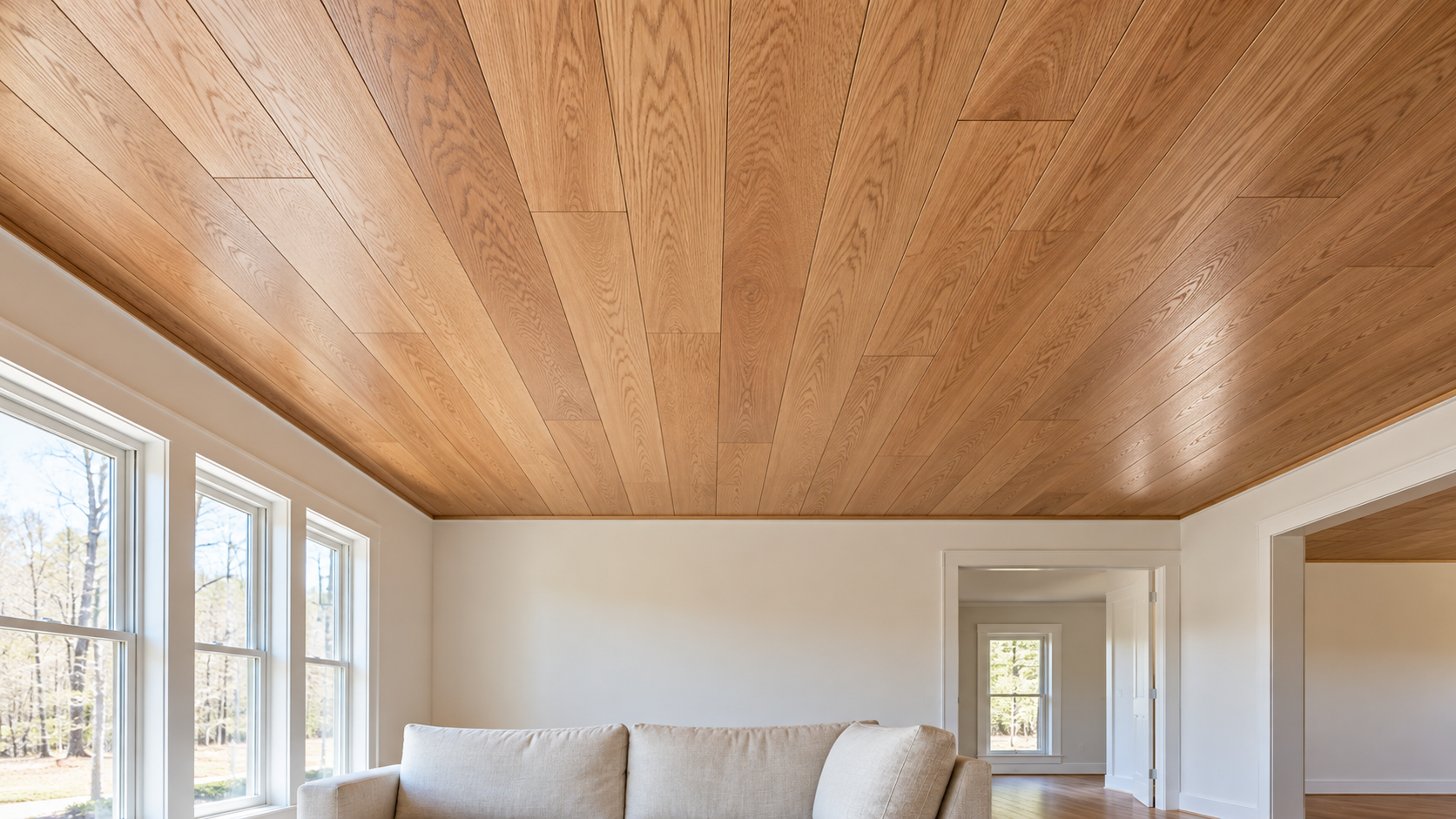
Indiana oak trim starts with a question homeowners ask nearly every week: white oak or red oak? Both mill clean, both hold a crisp profile, and both take a sprayed finish beautifully. The answer turns on grain, on the color that comes up under stain, and on what the wood lives next to once it is on the wall.
White oak or red oak: which one is right for Indiana oak trim?
Pick the species that agrees with what is already in the room. Red oak is the honest choice in the thousands of central Indiana houses built through the 1990s and 2000s, where red oak floors, doors and stair rails set the tone. White oak makes more sense when the room is moving toward browner, cooler tones, or when the new woodwork should read as its own piece rather than a match.
Radford Woodworks builds in both. The decision usually takes fifteen minutes in the room with a flooring sample in hand, and it is far easier to settle before material is ordered than after a ceiling is up.
How do white oak and red oak differ?
The differences are structural, not cosmetic, which is why they hold up under finish. The USDA Forest Products Laboratory separates the two by pore structure: red oak generally lacks tyloses in its pores, while white oak heartwood pores are usually plugged with them, making white oak hard for liquid to move through. That one trait explains white oak barrels, and why white oak behaves better anywhere moisture lingers.
| Attribute | White oak | Red oak |
|---|---|---|
| Grain and figure | Straighter and tighter, with a calmer pattern across a wide board | More open and coarse, with stronger swirl and cathedral figure |
| Natural color | Heartwood runs light grayish brown to brown | Heartwood carries a warm reddish cast |
| Under stain | Browns and greiges stay true, so cooler modern colors land where you expect | The red undertone pushes through most stains, warming the final color |
| Quartersawn ray fleck | Broad, long rays that flash across the face of the board | Rays present but shorter and less pronounced |
| Weight and movement | Somewhat heavier than red oak on average | Fairly high shrinkage in drying, so acclimating matters |
| Where it lands | Feature walls, islands, hoods, wet areas, browner palettes | Ceilings, slat walls, beams, and any room matching existing red oak |
Quartersawing either species brings the rays to the face of the board, which is where oak stops looking ordinary. Red oak’s tendency to move as it dries is why material is stacked in the house before install rather than carried straight off the trailer to the saw.
Which 7 Radford Woodworks oak builds show the difference?
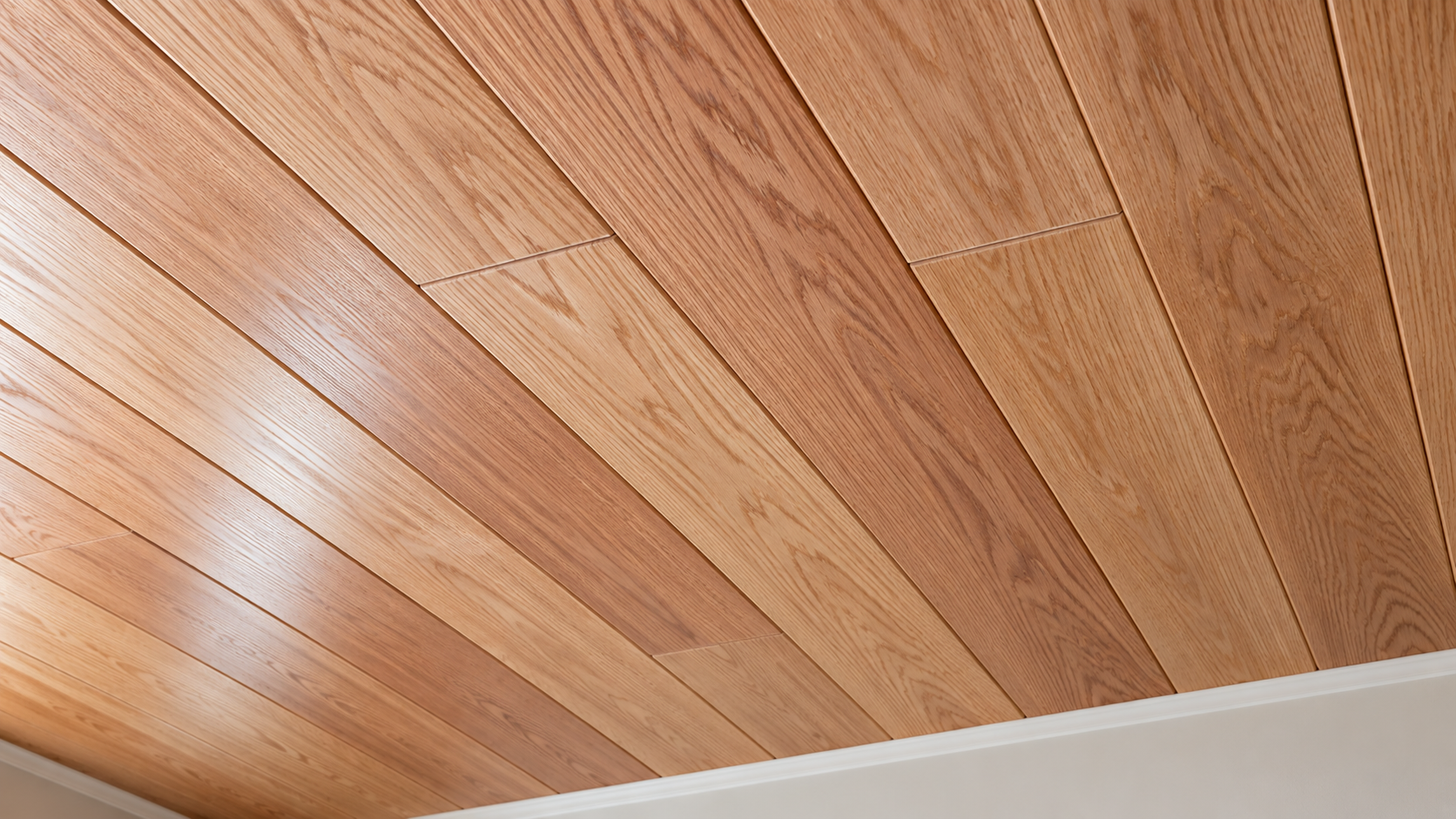
1. Red oak plank ceiling
Wide red oak planks give the species room to do what it does best. The cathedral figure reads clearly from below, and the warm cast keeps a tall room from feeling cold. Planks run long where the framing allows, joints staggered so the eye follows the boards rather than the seams.
2. Red oak tongue-and-groove ceiling
Tongue-and-groove locks board to board and hides fasteners in the joint, so the finished surface is uninterrupted red oak. The narrower boards read as a rhythm instead of a field, which suits a porch ceiling or a nook. Blind nailing through the tongue keeps every face clean.
3. Red oak slat wall
Slats turn oak into light and shadow, and red oak’s open grain gives each slat texture up close. Spacing is set against the wall’s width so the last slat lands full rather than ripped thin, and the backer is painted dark so the gaps read as shadow lines.
4. White oak inlay on a geometric island
Set against paint, white oak inlay shows exactly why the species is worth ordering. The browner tone holds its own next to a saturated color without the pink flash red oak would bring, and the tighter grain keeps a small panel from looking busy. Every joint in geometric work is cut tight because no trim hides behind it.
5. Oak mantles
A mantle is one solid piece at eye level, which makes grain selection the whole job. Red oak pairs naturally with red oak floors below. White oak suits stone, black paint and cooler surrounds, where a red cast would fight the wall.
6. Oak floating shelves
Solid oak shelves can be milled thick enough to read as architecture, then scribed to a stone or shiplap wall so they sit tight against an uneven surface. Grain is matched to the mantle when both share a room, since two different oaks a few feet apart is the mismatch people notice without knowing why.
7. Oak beams
Box beams built from stained oak stock give a ceiling weight and shadow. Corners are mitered so no end grain shows and the beam reads as solid timber. Species follows the room: red oak where floors and rails already are, white oak where the palette has moved on.
Why is stained wood back on top?
Wood has retaken the lead in kitchens, and trim follows the cabinets. In the 2026 U.S. Houzz Kitchen Trends Study, wood cabinets reached 29%, a 6-point jump that pushed white into second at 28%. Medium wood tones led at 15%, light wood at 11%.
Color forecasting points the same way. At The Inspired Home Show in March 2026, Pantone Color Institute’s Leatrice Eiseman revealed the seven Pantone View Home + Interiors 2027 palettes, among them Honest, built on warm browns, reds and oranges, and Grounded, drawn from earth tones. Both sit in stained oak territory.
The practical read for an Indiana homeowner: stained oak that looked dated in 2015 now looks current, and much of the material was already in the house.
How does Radford Woodworks finish oak so the color stays even?
Even color on oak comes from preparation, not the stain can. Sanding runs progressively through grits so no coarse scratch is left to grab pigment, and every piece in a run gets the same treatment so one board does not finish darker than its neighbor.
Wood conditioner goes on where blotching is likely, end grain and softer boards especially, so the stain sits rather than soaks. Sample boards come from the same lot as the job material, because oak from two bundles can take one stain two ways.
The finish is sprayed, which lays down an even film with no brush or roller marks. All faces are sealed, backs included, so both sides of a board meet Indiana’s humidity swings the same way and the finish holds through furnace season.
What should you bring to the quote?
Three things make the species decision fast and accurate: a flooring sample or offcut, a cabinet door or drawer front, and photos of the room in daylight and again under lamps at night.
Add the sheen already in the room, satin or semi-gloss, and any color the paint is going. Oak looks different against warm white than against deep green, and that call is easier to make in the room with real material than on a screen.
Frequently asked questions
Can new oak trim match my existing red oak floors?
Red oak new work matches red oak floors far more reliably than white oak does, because the reddish cast is a property of the species rather than the stain. Even then the match is close, not identical, since floors amber with age and sunlight. Radford Woodworks makes sample boards against the actual floor before ordering material.
Why does my red oak look pink?
Red oak heartwood carries a natural reddish cast, and most stains let it come through rather than cover it. Older finishes amber over time, pushing the tone further toward pink or orange. Getting away from that look means a stain with cool pigment to counter it, a heavier-bodied finish, or white oak on the new work.
What makes white oak cost more than red oak?
Supply and demand account for most of it, since white oak is in heavy use for flooring, cabinetry and barrels. Quartersawn white oak costs more again, because quartersawing yields less usable board per log and takes longer to mill. Radford Woodworks prices each project as a complete job, so the species difference shows up in the number rather than a separate material line.
What sheen looks right on stained oak trim?
Satin is the usual answer for stained oak in a living space. It holds a soft reflection, wipes clean, and does not throw light back at every ripple the way semi-gloss does. Flatter finishes look lovely on a ceiling, less so on a mantle or shelf that gets handled.
Bring a flooring offcut and a photo of the room, and the white oak or red oak question usually answers itself in one conversation. Radford Woodworks designs each wall, ceiling and built-in for the actual room it goes in. Send photos through the wall quote form when you are ready to talk it through.