
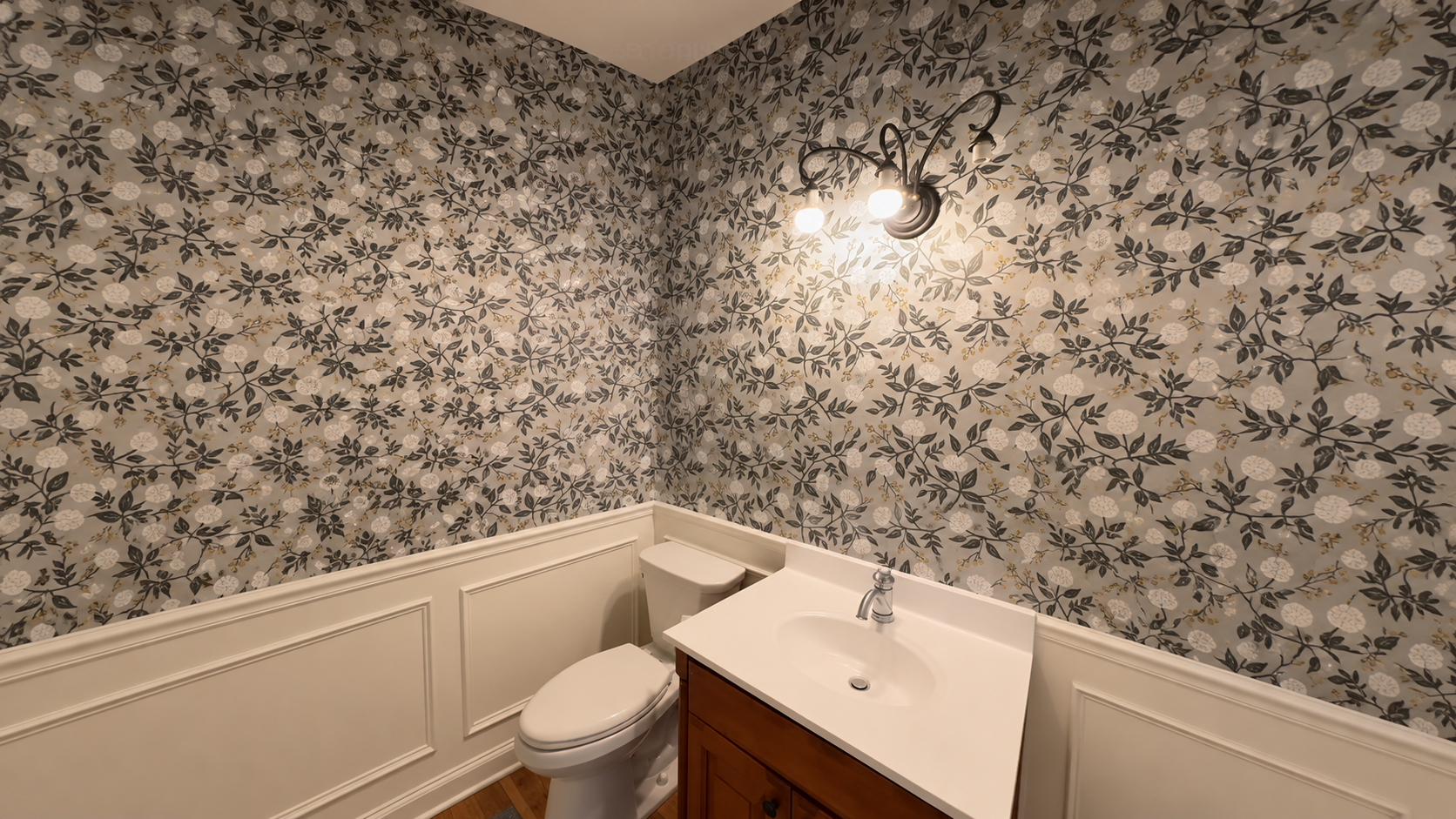
The powder room in the photo below is the kind of room most newer homes in Westfield, Fishers, or Greenwood leave as flat drywall. In this one, a charcoal botanical print covers everything above the cap rail, white wainscoting holds the splash zone, and the smallest room in the house became the one worth photographing. Wallpaper did the talking; trim carpentry made it work.
Wallpaper has stepped out of the powder room. Designers interviewed by House Beautiful in January 2026 say clients who once settled for one accent wall now paper whole rooms, ceilings, and kitchens. This guide covers what wallpaper is made of, the nine trends worth knowing, which type survives an Indiana summer, and what installation costs in 2026.
At a Glance
- Designers interviewed by House Beautiful and Good Housekeeping in early 2026 report wallpaper moving out of the powder room and onto ceilings, into kitchens, and across whole rooms.
- Houzz searches for “linen wallpaper” rose 104% and “seagrass wallpaper” 94% in early 2026; “wainscoting” searches rose 32% over the same period.
- Professional installation runs $325 to $825 for a standard room, about $3 to $8 per square foot with materials and labor (Angi, May 2026).
- Hang paper at 60 to 80°F and 30 to 50 percent humidity; air above 60 percent humidity can trap moisture and grow mold behind the paper (Angi).
- The most forgiving pairing in a central Indiana home: wainscoting on the lower third of the wall, wallpaper above the cap rail.
What is wallpaper, and how is it made today?
Wallpaper is a decorative wall covering sold in rolls or panels and fixed to the wall with paste or a self-adhesive backing. A modern roll has two layers: a backing of paper, fabric, or non-woven fiber, and a face that is printed, embossed, vinyl-coated, or woven.
The backing decides how the paper behaves. Paper backings absorb paste and expand, so installers fold each pasted strip and let it relax, a step called booking, before hanging it. Non-woven backings blend cellulose with synthetic fibers, hold their size wet or dry, take paste straight on the wall, and strip off in one dry sheet. Vinyl-faced papers are the workhorses for kitchens, baths, and hallways.
Paper hangs one of three ways: pre-pasted, unpasted, or peel-and-stick. Angi’s 2026 guide to wallpaper types warns that pre-pasted adhesive can swell and let go in damp rooms, which is why baths call for vinyl or non-woven paper hung with a separate adhesive.
What are the biggest wallpaper trends for 2026?
The 2026 wallpaper trends favor texture you can feel, patterns drawn by hand, and paper used in more places than one feature wall. Two national designer roundups, House Beautiful in January and Good Housekeeping in February, plus Houzz search data, point in the same direction.
1. Paper framed by trim and wainscoting
Designers are treating wallpaper like millwork. In Good Housekeeping’s roundup, Meghan Jay set a powder room’s paper inside the wall paneling so it reads like framed art, and Yena Jung papered the paneled back of a living room built-in. That is the pairing in both photos here: paneling below, print above.
2. Textures you can feel
Grasscloth, linen, seagrass, and tweed lead the material story. The 2026 U.S. Houzz Emerging Summer Trends Report shows searches for “linen wallpaper” up 104% and “seagrass wallpaper” up 94% year over year, and House Beautiful’s designers are going further with paper-backed linen, velvet, and embroidered panels.
3. Small-scale florals and block prints
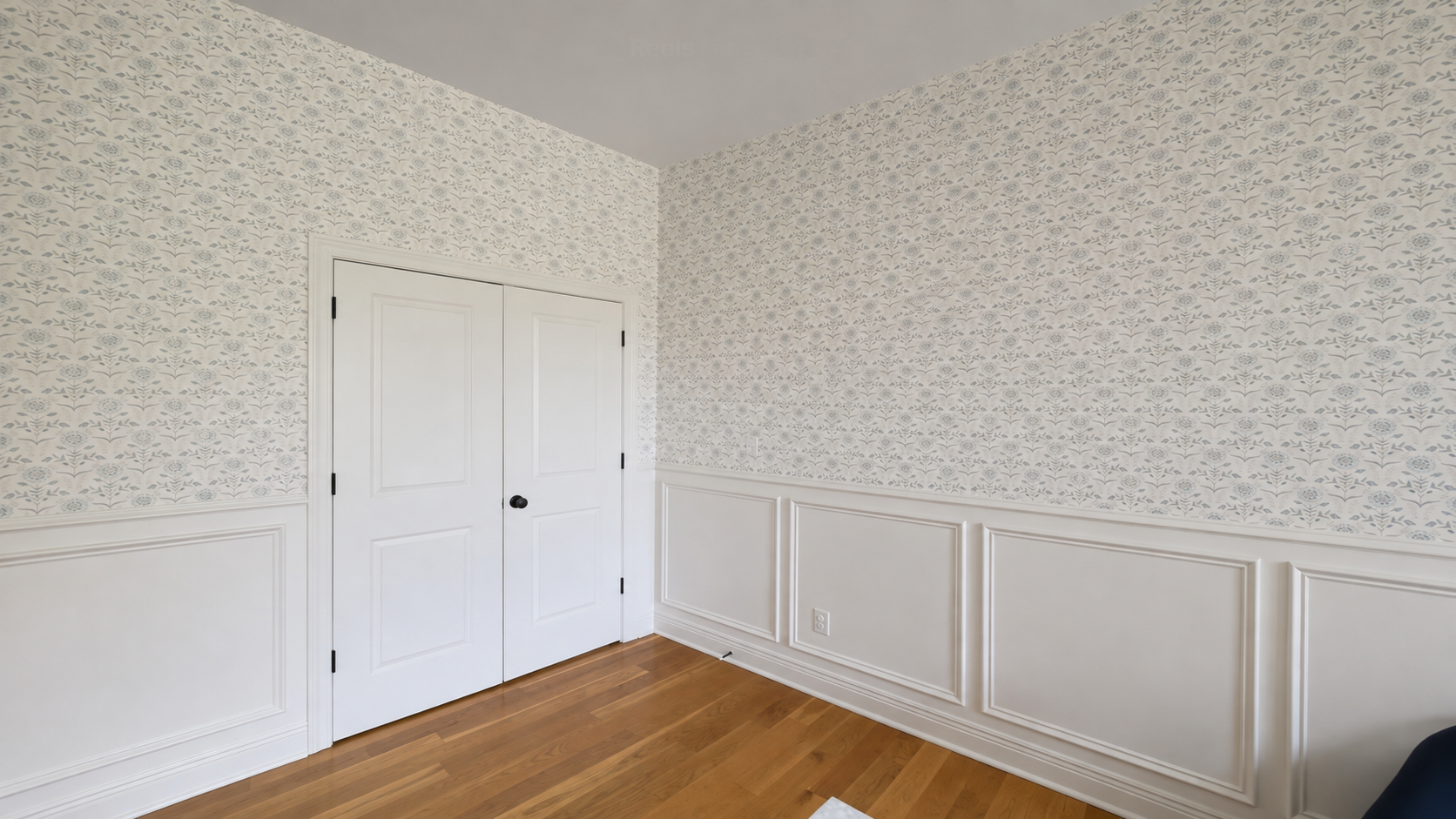
Small florals hold their own against big patterns. Designer Jennifer Pacca told Good Housekeeping that tight floral repeats add warmth and a touch of nostalgia while still feeling current, and House Beautiful counts block-print repeats among the year’s hand-touched looks. The gray floral in the bedroom photo is a textbook case.
4. Scenic murals and panoramic panels
Hand-painted scenes that wrap a room are the statement move of 2026. House Beautiful describes them as a way to make a room feel like a different place entirely, and Good Housekeeping’s Tobe Morrow says scenic panels make a room feel finished.
5. Ceilings and pattern drenching
The single accent wall has given way to papering everything, ceiling included. House Beautiful’s designers run one pattern across walls and ceiling to bring down an oversized room or hide odd angles, and Good Housekeeping’s Kelsey Matyas treats the ceiling as a fifth wall worth the same care.
6. Wallpaper in the kitchen
Kitchens are the newest room to get papered. Designers told House Beautiful that print softens the hard lines of cabinetry, and that the cautious route is a low-contrast pattern that reads as texture. A washable vinyl kept above the backsplash is the practical version.
7. Small doses in unexpected places
Not every wall needs paper. The back of a bookcase, a tub niche, a pair of closet doors, or one panel of a built-in can carry a print without committing the whole room, a move House Beautiful calls micro moments.
8. Trim painted to match the paper
White trim is no longer the only answer. Designer Maggie Goodrich told Good Housekeeping to expect more wallpapers paired with trim painted in a coordinating color pulled from the print, which turns the wainscoting into part of the pattern instead of a frame around it.
9. Borders, reworked
Wallpaper borders are back in a quieter form. House Beautiful reports designers using grosgrain ribbon or a painted band where a paper border used to go, often to trace an angled ceiling or outline a foyer.
Which type of wallpaper should you choose?
Match the backing to the room’s moisture and traffic first, then choose the pattern. Vinyl or non-woven paper belongs in kitchens, baths, and hallways; paper, grasscloth, and fabric belong in bedrooms, dining rooms, and studies.
| Wallpaper type | Material cost per sq ft (Angi) | Expected life (Angi) | Best rooms |
|---|---|---|---|
| Standard paper | $0.50 to $2 | 5 to 15 years (pre-pasted) | Bedrooms, dining rooms, offices |
| Vinyl and washable vinyl | $2 to $5 | 10 to 15 years (washable up to 20) | Kitchens, powder rooms, mudrooms, halls |
| Grasscloth | $5 to $12 | 10 to 15 years | Dry, low-traffic rooms; ceilings |
| Fabric and textile | $4 to $10 | 10 to 15 years | Bedrooms, dens, libraries |
| Peel-and-stick | $1 to $6 | 3 to 10 years | Rentals, kids’ rooms, trial runs |
| Custom mural | $10 to $50 | Varies with the base material | Dining rooms, entries, playrooms |
Material prices and life spans come from Angi’s 2026 cost and wallpaper-type guides. Two rules hold across brands: order patterned paper with about 10 percent extra for pattern matching (Angi’s wallpaper calculator), and keep grasscloth out of splash zones because it stains and fades.
How much does wallpaper cost to install in 2026?
Professional wallpaper installation runs $325 to $825 for a standard room, with a national average of $600, according to Angi’s cost guide updated May 30, 2026. That works out to roughly $3 to $8 per square foot with materials and labor included.
Room size moves the number most. Angi puts a single accent wall of 30 to 60 square feet at $120 to $500, a small bathroom up to 50 square feet at $200 to $500, a standard bedroom at $400 to $1,200, and a large living room at $1,000 to $2,400.
Prep is the line most homeowners forget. Angi lists wall repair and priming at $50 to $300 per wall, removal of old paper at $1 to $3 per square foot, and tall ceilings at another $100 to $500 per room. Premium material moves the total fastest: grasscloth runs $5 to $12 per square foot before labor, and printed-to-order murals $10 to $50.
Does wallpaper hold up in Indiana’s humidity?
Yes, when it is hung in the right conditions and the right rooms. Angi’s installation guidance calls for a room between 60 and 80°F and 30 to 50 percent relative humidity, and warns that air above 60 percent humidity can trap moisture behind the paper and grow mold.
Central Indiana swings past both ends of that range. July and August air is heavy, and a house with the windows open runs well above the 50 percent line; January furnace heat can push indoor air below 30 percent and open seams on freshly hung paper. Run the air conditioning during a summer install, let the rolls sit in the room for a day first, and hold the thermostat steady for a few days afterward.
Room choice matters as much as weather. A powder room with an exhaust fan and no shower takes vinyl or non-woven paper above wainscoting without trouble. A full bath with a daily shower needs washable vinyl and strong ventilation, and pre-pasted paper does not belong there at all.
How does wallpaper pair with wainscoting and trim?
Wainscoting below and wallpaper above is the most forgiving way to use pattern, and it is the combination behind both photos in this post. The trim takes the scuffs and splashes; the paper stays where hands, chair backs, and toothbrushes cannot reach it. Lauren Williams of MV Architects told Good Housekeeping her firm recommends this split in powder rooms so water never reaches the paper.
The cap rail does quiet work. A chair rail or paneling cap gives the paperhanger a level line to trim to and hides the cut edge, so the joint between wood and paper disappears. In the bedroom shown here, picture-frame wainscoting stops about a third of the way up the wall, which leaves the small floral enough height to read as a field rather than a stripe.
The paneling goes in and gets sprayed before the paper is hung, so the paperhanger trims to finished wood. Radford Woodworks lays out each box around outlets, doors, and windows, then finishes with an airless sprayer so there are no brush or roller marks along the cap.
Our guide to wainscoting styles, heights, and costs walks through the box layouts and cap heights that suit central Indiana homes. For rooms where you want wood instead of print on the upper wall, the Indiana accent walls guide covers full-height trim.
Wallpaper FAQ
Is wallpaper in style in 2026?
Yes. Designers interviewed by House Beautiful and Good Housekeeping in early 2026 report clients papering whole rooms, ceilings, kitchens, and the inside of built-ins, and Houzz search data show linen and seagrass wallpaper roughly doubling year over year. The looks gaining ground are textured, hand-drawn, and small-scale rather than glossy or loud.
Can you put wallpaper in a bathroom?
Yes, with the right paper in the right bathroom. Powder rooms and half baths take vinyl or non-woven wallpaper well, especially above wainscoting that keeps water off the paper. A full bath with a daily shower needs strong ventilation and a washable vinyl, and pre-pasted paper should stay out of it.
How much does it cost to wallpaper a room?
Angi’s May 2026 cost guide puts professional installation at $325 to $825 for a standard room, averaging $600, or about $3 to $8 per square foot including materials. A single accent wall runs $120 to $500, and premium grasscloth or custom murals push totals higher.
Should wallpaper go above or below the chair rail?
Above. Wainscoting on the lower third of the wall takes the wear, and the cap rail gives the paper a clean edge to stop on. Painting the trim in a color pulled from the print is the 2026 twist on the classic white pairing.
Ready to frame the paper you love?
If a room in your home needs the kind of wall people remember, we would enjoy seeing it. Send a photo (and the paper you have picked out, if you have one) through the wall quote form for a design and price, or contact Radford Woodworks at (317) 739-8555. The project gallery shows more of the trim work behind rooms like these.