
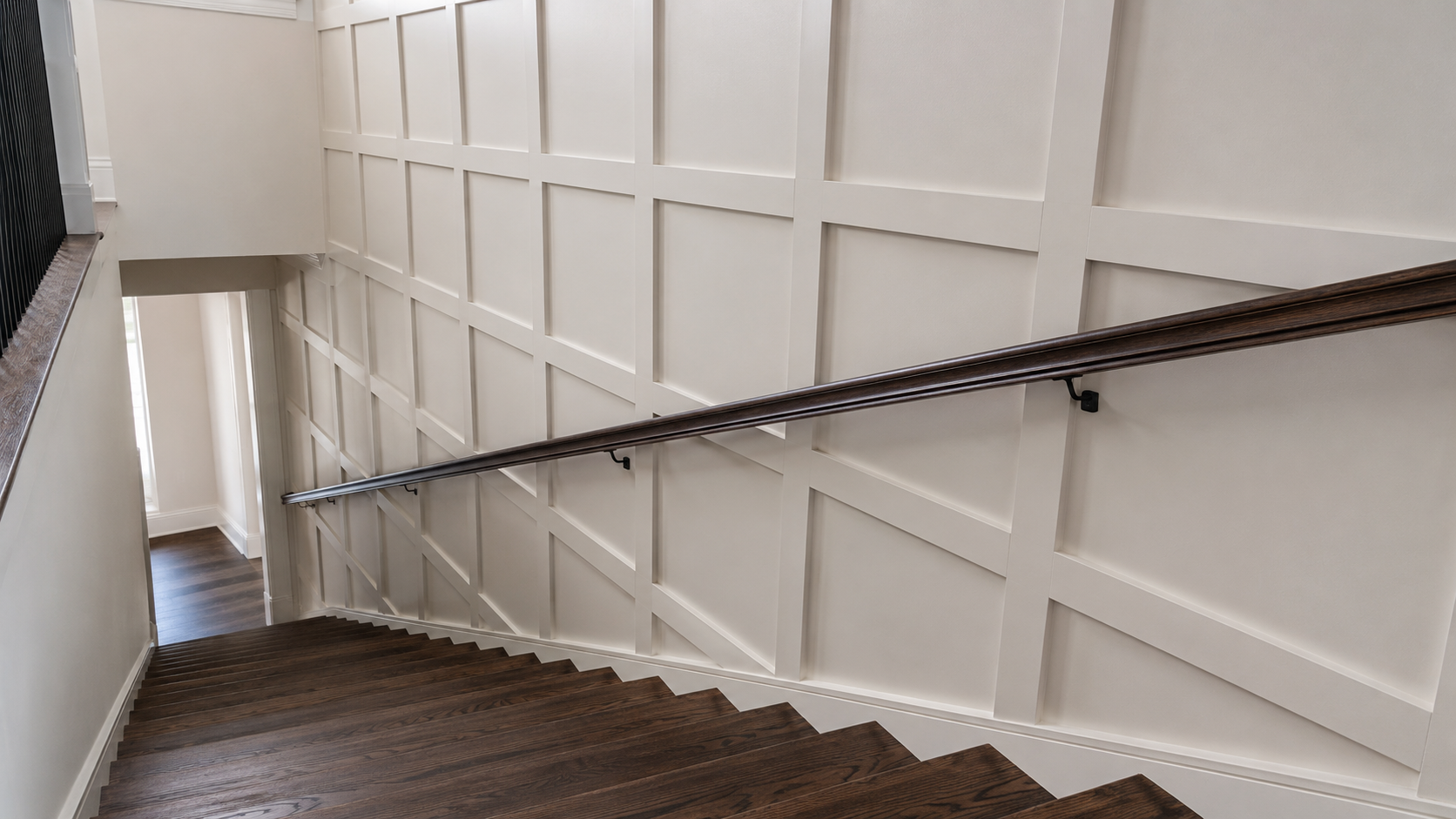
Stand at the top of a two-story stairwell and look at the wall most builders leave as a tall, blank sheet of drywall. In a Zionsville home, Radford Woodworks turned that exact wall into a full-height grid of painted battens that runs from the lower landing to the second floor and reads as architecture, not decoration. Indiana grid walls deserve the attention they are getting this year, and the reason is easy to see: they turn the largest surface in a room into its most finished feature. The ten answers below cover what a grid wall is, the styles designers favor, what one costs, and the build details that make it last.
1. What Is a Grid Wall?
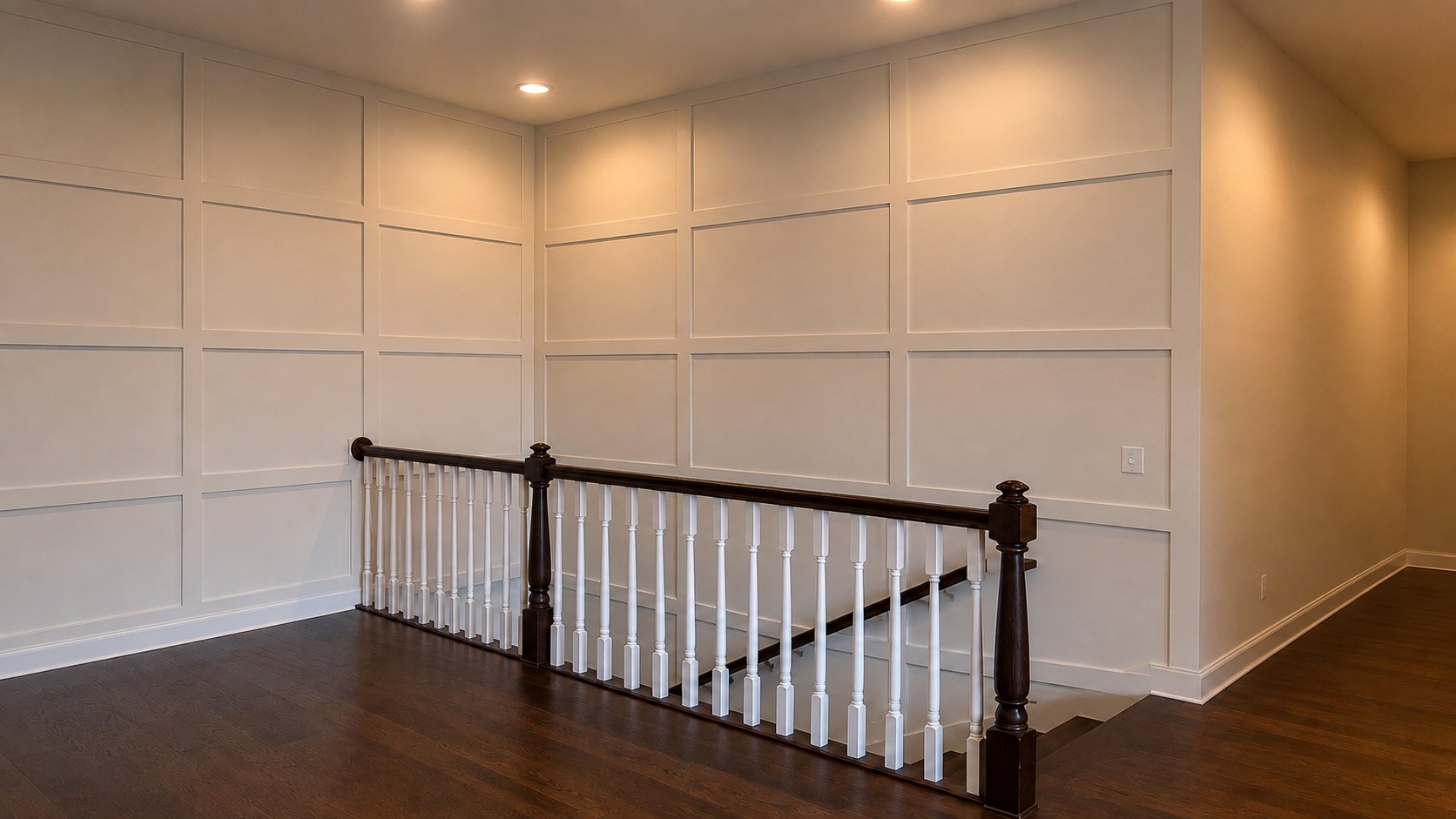
A grid wall is a wall treatment made of identical, evenly spaced elements, either painted wood battens or matching picture frames, arranged in a uniform matrix of squares or rectangles. A gallery wall works through mismatched sizes and loose spacing. A grid wall trades that looseness for precision, and that precision is the whole point: the batten version belongs in the hands of a finish carpenter with a laser level and a stack of spacer blocks.
2. What Are the 3 Grid Wall Styles Designers Love?
Three versions of the grid wall are showing up in 2026 homes, and they share one rule: every unit is the same size, and every gap is the same width.
The framed grid is the decorative version: identical frames hung in a strict matrix, popular for family portraits and print collections. The painted batten grid is board and batten turned into squares, built from trim stock glued and nailed over drywall, and it is the version in the stairwell photographed in this post. The inset-molding grid adds a small profile, such as base cap, inside each square so the wall reads as traditional paneling; Radford Woodworks used that detail on a stairwell grid with inset base cap earlier this year. Radford Woodworks builds the two batten versions, and they are the focus of this guide.
3. Is a Grid Wall the Same as Board and Batten?
No. Traditional board and batten runs battens vertically over a flat field, while a grid wall adds horizontal battens at the same spacing so the wall breaks into squares. Same trim stock, same fasteners, same paint, different geometry, and about twice the layout math. A vertical wall reads as classic and understated; the grid reads as a statement, with more visual weight and far less room for a crooked line. Our board and batten guide covers the vertical version.
| Feature | Grid wall | Gallery wall | Vertical board and batten |
|---|---|---|---|
| Layout logic | Uniform matrix, equal spacing | Mixed sizes, loose spacing | Vertical strips only |
| Install tolerance | Tight; every opening must match | Loose; adjust by eye | Moderate; one spacing to hold |
| Reads as | Structured, architectural | Personal, layered | Classic, transitional |
| Best rooms | Stairwells, TV walls, owner’s suites, photo displays | Eclectic collections, casual spaces | Hallways, bathrooms, mudrooms |
4. Why Are Designers Calling Grid Walls the New Gallery Wall?
Designers favor grid walls because uniform spacing creates calm, ordered visual interest without reading as flat or plain. In a Good Housekeeping feature on the trend, Minnesota designer Bria Hammel said the look gives a room structure and symmetry while still leaving room for personal style in what fills each square, and Denver designer Nadia Watts described a “quiet power in their order that truly anchors a room.”
That consistency is why the idea carries over so well to full batten treatments: the eye reads repetition as workmanship. Hammel’s advice for frame grids applies to built ones too. Plan the spacing before anything goes on the wall, keep every unit the same size, and never crowd the layout.
5. Why Are Indiana Grid Walls Trending in 2026?
Homeowners are trading the single wall of accent paint for surfaces with texture and shadow, and the search data backs that up. The 2026 U.S. Houzz Emerging Summer Trends Report found U.S. searches for “wainscoting” up 32% and “chocolate brown” up 153% year over year, part of a wider move toward tactile, touchable walls. House Beautiful reported the same request reaching designers from clients: wall finishes with more texture than a coat of paint can give.
Finish decisions carry real money, too. Zillow’s 2026 Paint Color Analysis found buyers may offer an estimated $2,277 more for a home with a chocolate brown bedroom than a white one, and $1,723 more for a pale blue living room, while sage green ranked in the top tier for every room tested. A grid wall is a natural place to make that finish call: the whole assembly can be sprayed one deep tone, painted in contrast to the field, or built from stain-grade wood and left natural.
6. How Do You Plan a Grid Wall Layout?
Planning starts with measuring the wall’s height and width, subtracting the outer border, then dividing both directions by a target opening size until every square comes out identical. Most rooms look right with openings between 18 and 24 inches, and a two-story stairwell can carry larger openings because the scale of the wall is bigger. Cut two spacer blocks to the finished opening and set every batten off the blocks, because a tape measure drifts over a long wall and a block does not.
Outlets, switches, windows, and the stair rake all need a home in the plan before a single nail goes in. On a stairwell, the battens along the stair run at the same angle as the treads, so the mitered joints where they meet the level grid get laid out on the wall first. Indiana’s swing between a humid July and a furnace-dry January also moves solid wood, which is why solid battens should sit in the house for a few days before install.
7. What Materials and Finish Make a Grid Wall Look Built-In?
Real trim stock, filled and caulked joints, and a sprayed finish are what make a grid wall look like part of the house rather than something applied to it. Primed MDF gives a dead-flat face and stays put through humidity changes, while poplar or pine resists dents better in busy spots like stair landings. Peel-and-stick grid film and foam trim look fine for a season; they do not hold a line for a decade.
The build sequence is always the same: outer border first, then the vertical battens, then the horizontals set with the spacer blocks. Every nail hole gets filled, every seam gets caulked, and the whole wall gets sanded and primed. Radford Woodworks then sprays the finish with an airless sprayer so the battens and the field read as one plane with no brush or roller marks. That last step is the difference between a wall that looks built-in and one that looks stuck on.
8. What Do Indiana Grid Walls Cost?
Angi’s March 2026 cost guide puts professionally installed wall paneling at $7 to $25 per square foot, with a national average around $2,800 and a single 8-by-10 accent wall landing between $500 and $1,000. Stairwells and multi-story walls sit above those figures because the working height adds labor.
Expect a grid wall to price above a vertical board and batten wall of the same size, since it uses roughly twice the batten stock and more layout time. Radford Woodworks designs each wall for the actual space and quotes Indiana grid walls as one complete job, materials, labor, and spray finish included.
9. Can You DIY a Grid Wall or Should You Hire a Pro?
A single flat accent wall is a realistic weekend project for a patient DIYer, and Angi puts materials for a do-it-yourself paneling job at $500 to $2,000. The trade-offs are real, though: the layout math has to come out even, a repeated cut that is slightly off compounds across the wall, and there is no warranty on the result.
A two-story stairwell is a different job. The work happens on ladders or scaffolding over open stairs, the battens meet the stair rake in mitered joints, and the spray finish takes masking and equipment most homeowners do not own. That is the version worth handing to a finish carpenter.
10. Where Does a Grid Wall Work Best?
A grid wall works best where a room needs a strong focal point that will not compete with furniture or art: a stairwell, the wall behind a TV, an owner’s suite headboard wall, a dining room, or a two-story entry. Because the pattern is built into the wall, it holds up in high-traffic spots in a way a wall of framed glass might not.
The Zionsville stairwell shows why. The grid climbs from the lower landing past the main floor to the upstairs hall, and the dark stained handrail and newel posts read as sharp lines against the white battens. Many central Indiana homes built since the 1990s, in Carmel, Fishers, Westfield, and Zionsville alike, have the same open stair halls waiting for the same treatment.
FAQ
What is the difference between a grid wall and a gallery wall?
A grid wall uses identical, evenly spaced elements in a strict matrix, while a gallery wall mixes frame sizes and spacing for a casual, collected look. Grid walls read as structured and architectural; gallery walls read as personal and layered.
Can a grid wall be built from real wood instead of MDF?
Yes. Poplar or pine battens cost more than MDF but resist dents better and hold a sprayed enamel finish for years. MDF stays flatter through Indiana humidity swings and is the practical choice for many painted walls. Radford Woodworks picks the stock based on the room, the finish, and how much traffic the wall will see.
How much space should be between grid wall battens?
Spacing is set by dividing the wall’s usable height and width by the number of openings wanted, and most rooms look right with openings between 18 and 24 inches. Taller walls, including two-story stairwells, can carry larger openings. The exact number comes from the wall’s dimensions so that every square matches.
Does a grid wall add value to a home?
No major study isolates grid walls, but the surrounding evidence is favorable. Angi estimates wall paneling recoups roughly 50 to 70 percent of its cost at resale, and Zillow’s 2026 Paint Color Analysis shows finished, warm-toned walls draw higher offers than plain white. Execution quality and the local market decide the rest.
Ready to Plan a Grid Wall?
If a blank stairwell or a bare TV wall has been bothering you, send Radford Woodworks a photo of the space through the wall quote form and you will get back a design and a price. To see finished grid walls, board and batten, and geometric walls, browse the gallery, follow Radford Woodworks on Instagram and Facebook as new builds wrap up, or call (317) 739-8555 and reach out through the contact page with any question about your wall.