
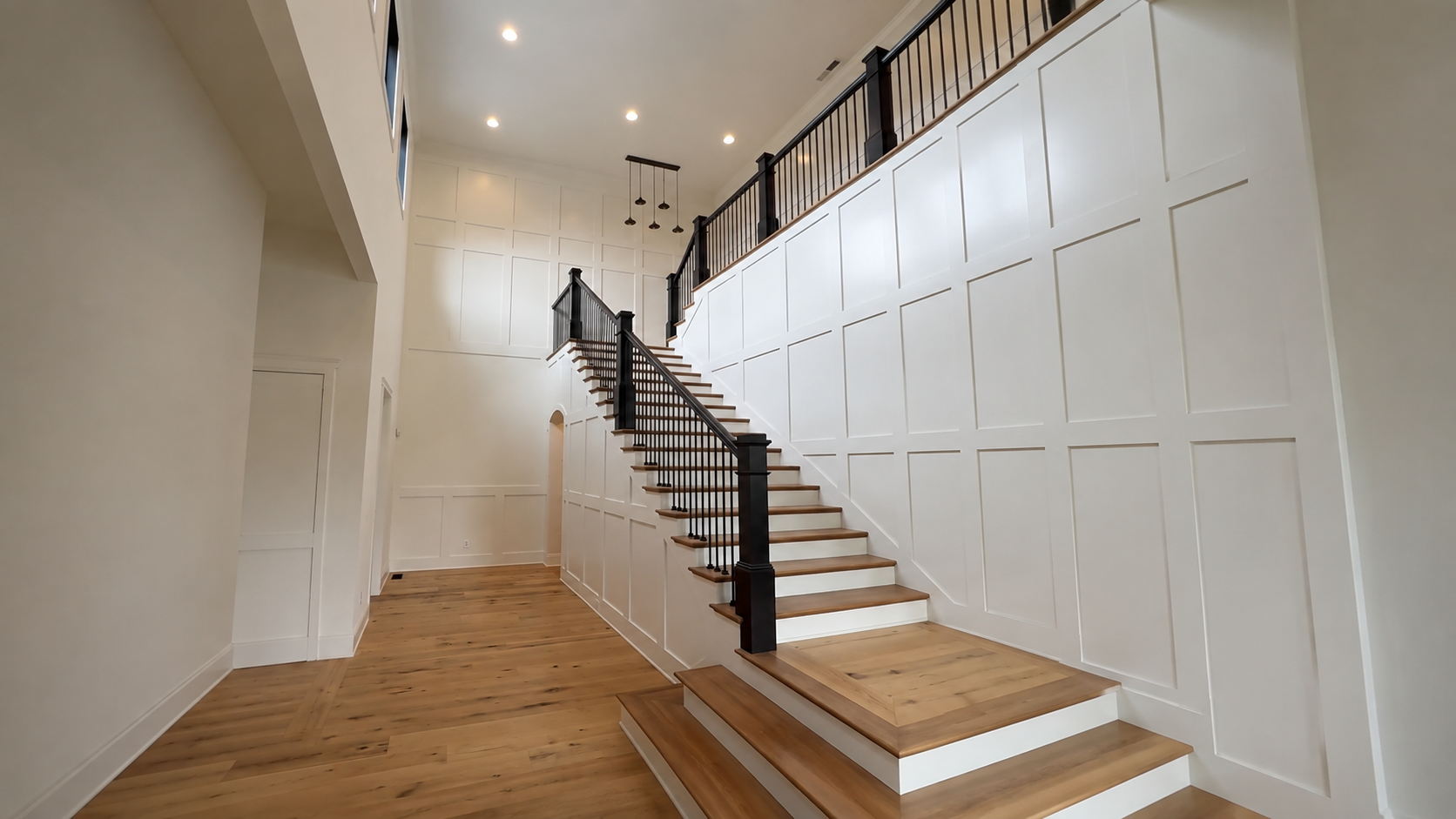
The stair wall in the photo above climbs two full stories, and every square on it was mapped out with a level and a story pole before the first piece of trim was cut. That is the real difference between picture frame molding that looks original to the house and boxes that look stuck on: the layout. Radford Woodworks builds picture frame molding and wainscoting in homes across central Indiana, and the two treatments come up together on nearly every walkthrough. This guide sorts out what each one is, what it costs in 2026, and nine looks worth studying.
What Is Picture Frame Molding?
Picture frame molding is thin decorative trim, usually base cap or panel mold, applied directly to drywall in rectangles and painted along with the wall. The boxes read as paneling, but there is no panel behind them, which keeps material cost down and install time short. You will also hear it called box molding, wall frames, or shadow boxes.
HomeAdvisor prices wall frames at $8 to $25 per linear foot and points out they turn up most often in high-end homes. Off-the-shelf versions come as premade squares. On custom work, each frame gets sized to its wall, mitered at the corners, and glued and pinned so the joints stay closed for good.
Picture Frame Molding vs. Wainscoting: What Separates Them?
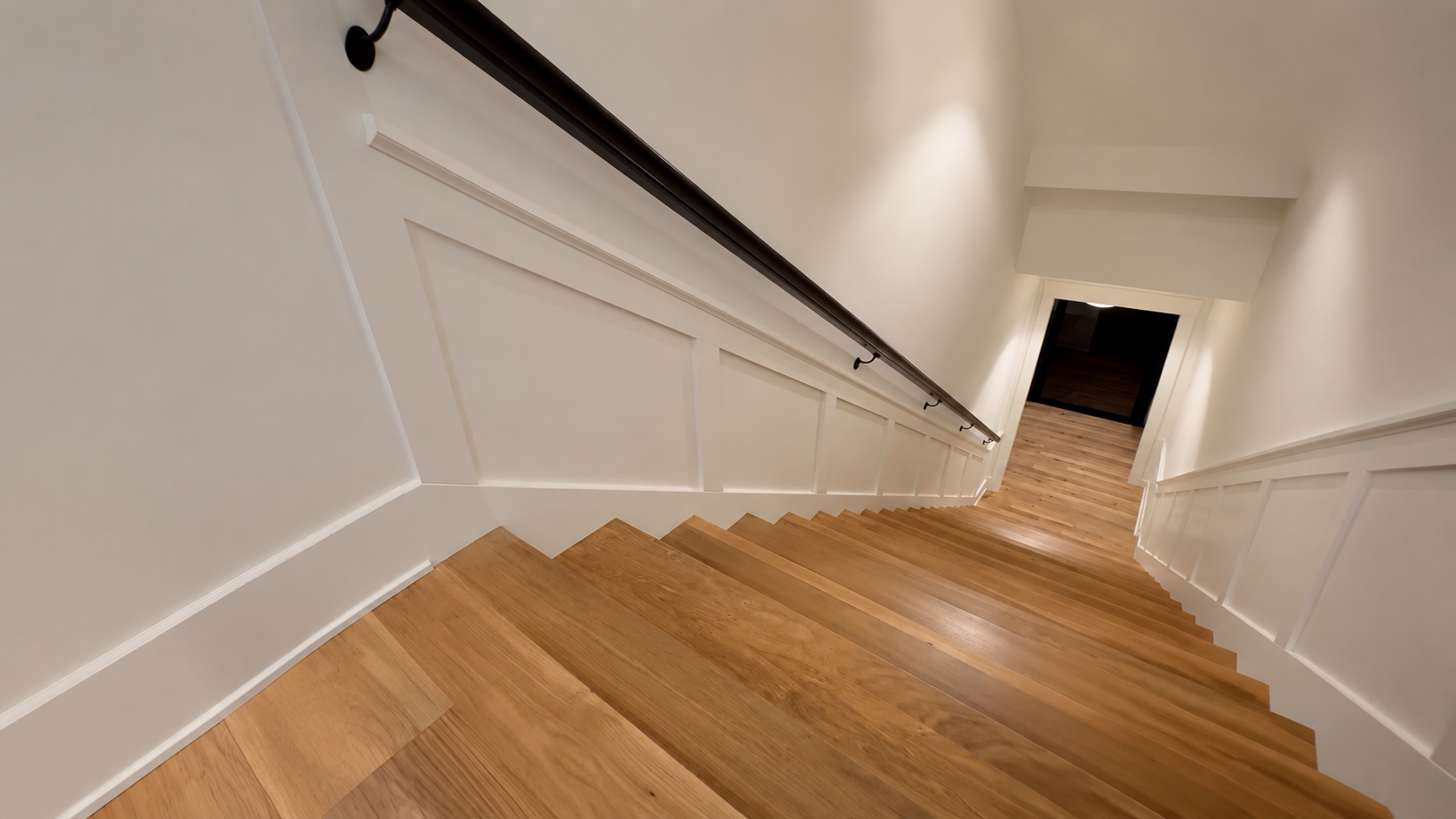
Wainscoting is a built paneling system with panels, rails, stiles, a cap, and a baseboard covering part of the wall in real material. Picture frame molding skips the panels and applies the frames straight to the drywall. Both organize a wall into shapes; one adds a full layer of woodwork, the other borrows the look for less.
| Treatment | What it is | Where it usually sits | 2026 installed cost |
|---|---|---|---|
| Picture frame molding | Trim boxes applied to drywall, painted with the wall | Any height, floor to ceiling | $8–$25 per linear foot (HomeAdvisor) Home Advisor |
| Wainscoting | Panel system with cap rail and baseboard | Lower third of the wall | $10–$40 per square foot (HomeGuide) HomeGuide |
| Picture rail | Slim horizontal rail that holds hanging hooks | Near the ceiling, around window-head height | $1–$3 per foot for the rail itself (HomeAdvisor) Home Advisor |
Our guide to wainscoting styles, heights, and costs walks through the panel side, including the one-third height rule and the five styles we build most.
What Is a Picture Rail, and Why Is It Back?
A picture rail is a single strip of molding that runs horizontally near the top of the wall and holds hooks for hanging art on cord or chain. Bob Vila describes picture rails as 1.5-to-2-inch strips set at the height of the window tops or a few inches below the crown, and their original job was practical: Victorian-era plaster was hard to nail into, so paintings hung from the rail instead.
The old idea is having a real moment. At London’s WOW!house design event this June, Livingetc found artwork suspended from rails in almost every room, tidier than a gallery wall and easy to rearrange. Designer Camilla Clarke of Albion Nord told the magazine a rail brings old-world charm to a scheme, and Collier Webb’s David Arratoon pointed to the working side of it: pieces slide, swap, and rehang without one new hole, which also spares wallpaper and specialty finishes behind the art. The same magazine named chair rails and paneling among 2026’s nostalgic comebacks, with designer Ashley Macuga calling the shift a quiet revival grounded in tradition and interior architecture.
9 Looks Worth Building in 2026
Nine ways these treatments earn their wall space:
- Classic boxes below a chair rail. The traditional dining room move: a rail at about a third of the wall height with evenly spaced frames beneath it. Margins matter more than box count. Keep the gaps between frames, rail, and baseboard consistent and the wall reads as one composition.
- Full-height frames. Stacked boxes running floor to ceiling pull the eye upward and make a nine-foot room feel taller. A tall lower box with a shorter one above is the proportion that flatters most rooms.
- Stair walls. Frames that climb with the staircase take the most layout work of any install, since the rake angle changes every cut. Done right, the wall carries you upstairs.
- Frames above wainscoting. True panel wainscoting below the cap, painted boxes above it. Two layers of woodwork give a formal room structure without darkening it.
- One color, top to bottom. Paint frames, wall, and rail a single shade and let sheen do the separating: satin on the trim, eggshell on the wall. The drenched look reads as texture instead of stripes.
- Wallpaper inside the boxes. HomeAdvisor calls out papered or contrast-painted frame interiors as a favorite upgrade, and a grasscloth or mural panel inside painted frames turns each box into its own framed piece.
- A rail that works. Run a true picture rail near the ceiling and hang art from hooks and cord, the way designers did across WOW!house this year. Swap pieces with the seasons without patching a single hole.
- Double frames. A second, smaller frame nested inside the first adds one more shadow line for formal spaces. Small material cost, a lot more presence.
- The squared grid. Swap profiled molding for flat stock and the boxes go modern: clean squares, tight reveals, no ornament. It is the look on the stair wall above, and a natural fit for newer Indiana builds.
Several of these looks are built out in our gallery if you want to see them on real walls.
What Does Picture Frame Molding Cost in 2026?
Plan on $8 to $25 per linear foot installed for wall frames, per HomeAdvisor’s 2026 pricing, with the spread coming down to profile size and material. Angi puts complete trim projects at a $1,390 average, with most jobs landing between $200 and $7,500 depending on how much wall gets covered, and finishing adds $1 to $4 per linear foot for paint or stain.
A single accent wall of six boxes in paint-grade MDF sits near the bottom of that range. A two-story stairwell with stacked frames, sprayed on site, sits near the top. Send a photo of your wall through our wall quote form and we will send a design and price back within 48 hours.
Making It Last in an Indiana Home
Central Indiana swings from humid Julys to furnace-dry Januarys, and trim moves with it. Paint-grade MDF stays flat on interior walls and takes paint without grain showing through, while poplar and pine handle profiled and stained work. Either way, material should sit inside the house a few days before install so it settles to the room.
We glue and pin every miter, then caulk and fill before finish coats, so joints stay closed when the seasons change. On stair walls and full-height work, spraying the finish lays down an even film across every face and edge, with no brush marks to catch the light.
Picture Frame Molding and Wainscoting FAQ
Is picture frame molding the same as wainscoting?
No. Wainscoting is a built paneling system with panels, a cap rail, and a baseboard, while picture frame molding is trim applied straight to the drywall with no panels behind it. The two are often combined, with frames above a wainscoted base. Picture frame molding gives a similar look at a lower installed cost.
What is the difference between a picture rail and picture frame molding?
A picture rail is one horizontal strip of molding near the ceiling, shaped to hold hooks for hanging art. Picture frame molding is a set of closed boxes applied across the wall as decoration. The names sound alike, but one is hardware for your art and the other is the artwork itself.
How much does picture frame molding cost to install?
Wall frames run $8 to $25 per linear foot installed in 2026, per HomeAdvisor, and Angi pegs complete trim projects at $200 to $7,500 with a $1,390 average. Box count, trim profile, wall prep, and paint decide where a job lands. A single accent wall costs far less than a stairwell or a full dining room.
Does picture frame molding work on textured walls?
Yes, with prep. Light texture can be bridged with caulk along every frame edge and disappears under paint. Heavy texture is better skim-coated first so the trim sits flush and the shadow lines stay crisp, and that prep is worth pricing into the job.
Picture frame molding is the fastest way we know to give a flat wall a reason to be looked at, and paired with wainscoting it can carry a whole room. If a wall in your entry, dining room, or stairwell is asking for it, give us a call or send a note through the contact page and we will walk the space with you. Repeat clients are the best compliment we get, like this Holliday Farms homeowner who came back for another build. New projects go up on Instagram and Facebook as we finish them, with more paneled walls saved on our Pinterest board.