
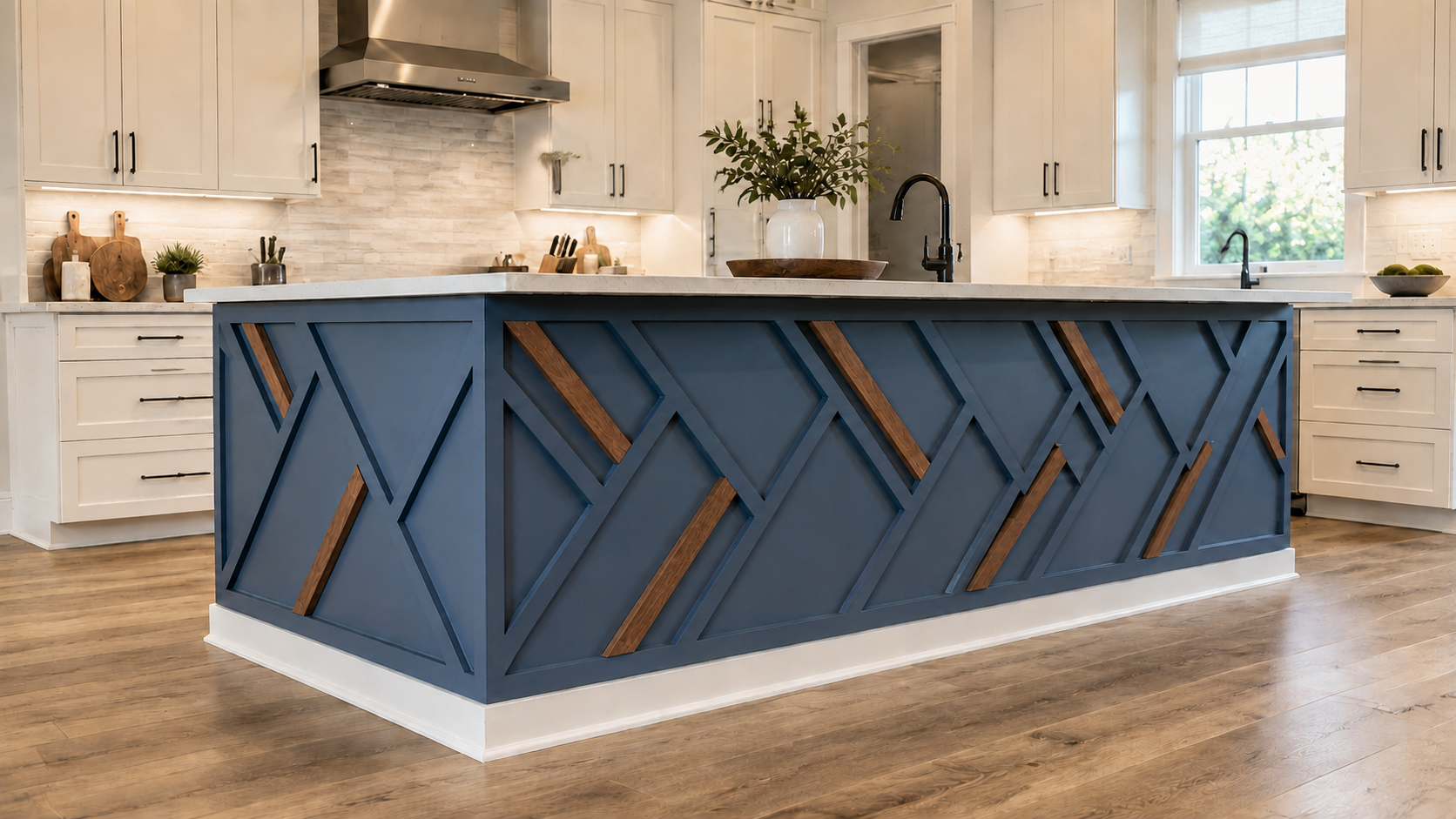
The island in one Westfield kitchen was a plain painted box until Radford Woodworks wrapped it in diagonal trim and set stained white oak into the pattern. Now it is the first thing guests notice. Indiana geometric walls do the same job on a larger surface: a flat wall gets a repeating pattern of wood, and the room gets shadow lines, texture, and a focal point that paint alone cannot produce.
At a Glance
- A geometric wall is any wall or panel where wood trim, slats, or paint lines form a repeating shape: diagonals, chevrons, hexagons, nested boxes.
- The 2026 U.S. Houzz Emerging Summer Trends Report found searches for touchable wall materials rising fast, with “sandstone” up 257% and “wainscoting” up 32% year over year.
- Angi’s 2026 data puts professionally installed wall paneling at $7 to $25 per square foot; detailed patterns land at the upper end.
- Painted patterns are built from primed MDF or poplar; stained accents need real hardwood such as white oak.
- The most common failure is a repeated cut that is one degree off, which shows up as a gap at the last joint.
What Counts as a Geometric Wall?
A geometric wall is a surface where wood battens, slats, or trim are arranged in a repeating shape rather than in straight vertical or horizontal runs. The shape is what separates it from board and batten or shiplap, even though the fastening and finishing steps overlap.
Two build methods cover nearly every version. Applied wood uses real battens or panels installed over drywall or a cabinet box, then painted or stained. Painted geometry uses tape and layered color to draw the pattern with no added material. Radford Woodworks builds the applied-wood version: milled trim, glued and nailed, then sprayed. For the simpler vertical layout, our board and batten guide covers it.
Why Are Indiana Geometric Walls Trending Right Now?
Homeowners are choosing texture over paint color, and the search data backs that up. The 2026 U.S. Houzz Emerging Summer Trends Report found U.S. searches for “sandstone” up 257%, “linen wallpaper” up 104%, and “wainscoting” up 32% year over year, comparing January through March 2026 against the same months in 2025.
Wood trim patterns sit squarely inside that shift. A geometric wall gives a room dimension that changes with the light through the day, using permanent millwork instead of a wall covering. In newer Westfield, Carmel, and Fishers subdivisions, where most walls are drywall and corner bead, one patterned wall reads as the architectural detail the house came without.
These five patterns cover most of the geometric walls going into Indiana homes right now. Each has its own layout method, margin for error, and best room.
1. Diagonal Lattice With Wood Inlay
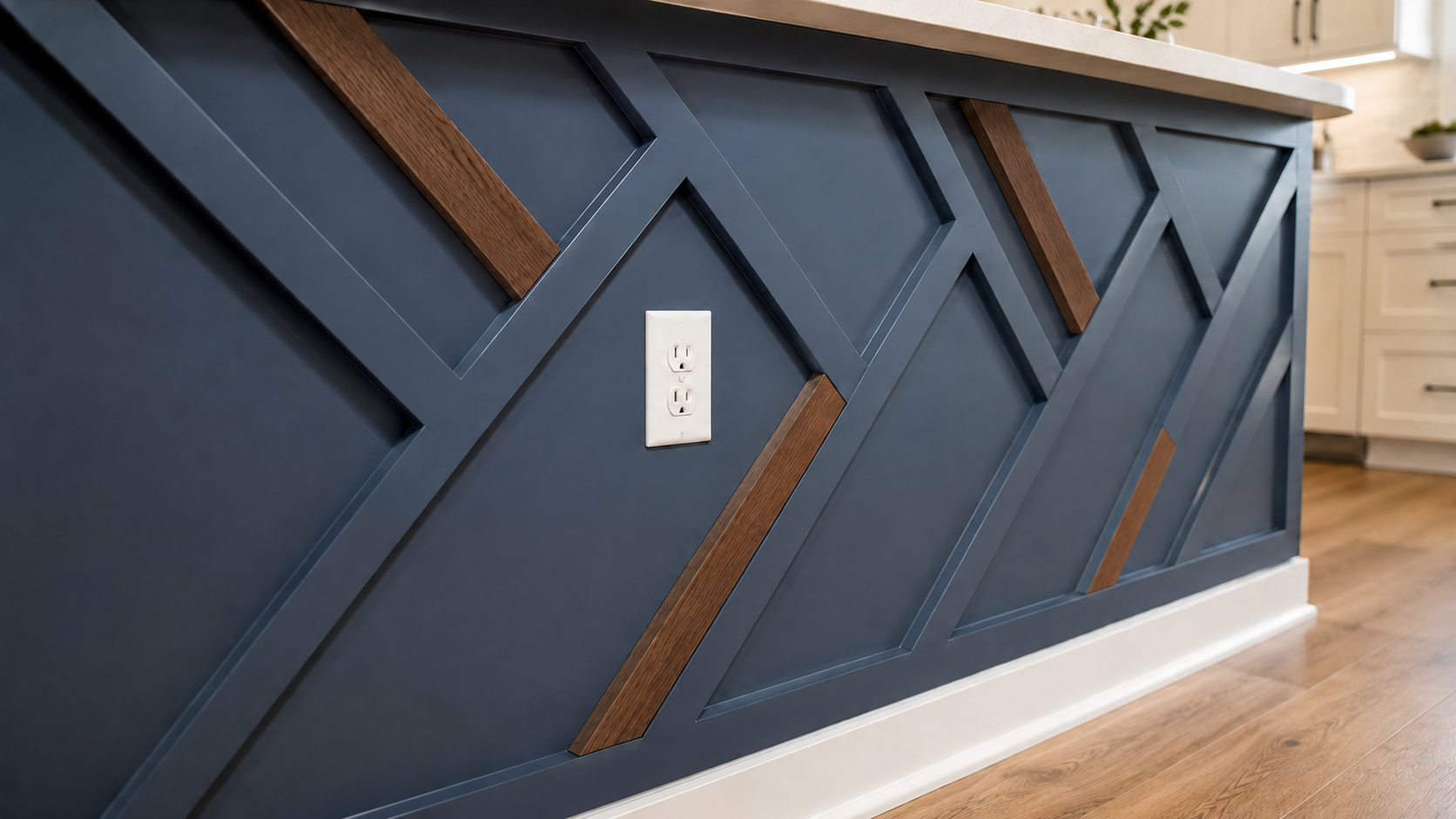
Parallel diagonals crossed by a second set of angles form a lattice of parallelograms, and swapping a few painted segments for stained wood turns the pattern into a conversation piece. That is the Westfield island: blue painted battens with white oak pieces set into the pattern at the same thickness, so the surface reads as one plane.
The technique that matters is the stop block. Every diagonal is cut on the miter saw at the same angle against the same stop, so the pieces are identical before they reach the wall. Best for kitchen islands, bar fronts, and entry walls.
2. Herringbone and Chevron
Herringbone and chevron both use angled boards, but herringbone staggers the ends while chevron cuts them to meet at a point. Herringbone hides a slightly long piece in the stagger; chevron shows every miss along its center line.
Snap a plumb center line first and build outward in both directions so any drift lands at the edges, where a trim piece can absorb it. Best behind a headboard or at the end of a long hallway.
3. Hexagon and Honeycomb
A hexagon wall is six-sided cells cut from 30-degree miters, repeated until the pattern fills the field. A wall of full and partial hexagons can run past a hundred pieces, so a plywood jig that holds every cell to the same size is how they stay identical.
Honeycomb pairs well with pendant lighting because each cell throws shadow in six directions. Best for dining rooms and powder rooms, where the wall is small enough to keep the cut count sane.
4. Nested Boxes and Offset Grids
Rectangles inside rectangles, or a grid shifted off center, is the most forgiving geometric pattern because every joint is a square cut or a 45-degree miter. It also plays best with a television. On a Westfield geometric TV wall, Radford Woodworks set a discreet outlet behind the screen to keep the cords out of sight; leaving a plain field where the screen hangs lets the pattern frame it rather than disappear behind it.
Plan outlets before the first batten goes up. Box extenders bring receptacles flush with the new surface, which electrical code calls for. Best for media walls and home offices.
5. Freeform Angles
Freeform angles are lines that never repeat, laid out to suit one wall, and they read like built-in art. They are also the easiest pattern to get wrong, with no repeat to check the work against. Draw the wall to scale, tape the full-size layout on the drywall, and live with it for a day before cutting.
A two-sheen finish makes this pattern pop: flat paint on the field, semi-gloss on the trim, so the lines catch light. Radford Woodworks has finished a geometric fireplace wall exactly that way. Best for fireplace faces, stairwells, and owner’s suites.
Wood Trim or Paint: Which Method Fits Your Room?
Real wood gives a geometric wall physical dimension and holds up in high-traffic rooms; a taped paint pattern costs less and installs faster but needs touch-ups. Choose based on traffic, budget, and how permanent you want the result to feel.
| Method | Installed cost (2026, per Angi) | How it wears | Best rooms |
|---|---|---|---|
| Taped paint pattern | $2 to $6 per sq ft for a plain accent wall, plus masking and layout time | Scuffs show; periodic touch-ups | Nurseries, small offices, rentals |
| Painted trim pattern (MDF or poplar) | $7 to $25 per sq ft installed; detailed patterns toward the top | Takes bumps; repaintable | Living rooms, islands, media walls, owner’s suites |
| Stained hardwood pattern or inlay | Upper end of that range; wood species sets material cost | Longest-lived; refinishable | Islands, entries, dining rooms |
How Much Does a Geometric Wall Cost in Indiana?
Expect professionally installed wall paneling to run $7 to $25 per square foot in 2026, according to Angi’s wall paneling cost data, with a simple 8-by-10-foot accent wall starting around $500 to $1,000 and detailed patterns priced above that. Angi puts standard installation labor at $3 to $10 per square foot and notes that custom layouts and detailed patterns take more skill and time. A plain painted accent wall runs $2 to $6 per square foot in Angi’s painting data.
Three things move the number: the cut count, the finish (stained hardwood costs more than primed MDF), and the wall itself (a 10-foot ceiling or a wrap-around island adds pieces). Radford Woodworks prices each project as a complete job for your actual wall, covering materials, labor, and spray finishing. Send a photo through the wall quote form and you will get a design and a price back.
Which Materials Hold Up in Indiana’s Humidity?
Primed MDF and poplar are the right stock for painted patterns, and real hardwood is the only choice for stained accents. Fine Homebuilding’s guide to paint-grade trim notes that MDF is more dimensionally stable than solid wood, so joints can be mitered instead of coped, though its edges are softer than poplar or finger-jointed pine. MDF also cannot get wet, so near a sink or along a mop line, poplar is the safer batten.
That stability matters in central Indiana, where a humid July and a furnace-dry January pull wood in opposite directions. Solid stock should sit in the house for a few days before it is cut, joints get glued as well as nailed, and the batten-to-wall edge gets caulked so hairline seasonal gaps fill and repaint cleanly. Stained pieces get finished before install and masked during spraying so the paint line stays sharp against the grain.
What Mistakes Ruin a Geometric Wall?
The most common failure is a repeated cut that is one degree off. It hardly shows on a single joint, but across twenty identical pieces it compounds into a visible gap or overlap at the last cell. Measuring twice is not the fix; cutting every piece against the same stop block and test-fitting one full repeat before committing is.
The second mistake is overloading the room. A geometric wall should be the one thing that gets attention, so skip heavy shelving, busy art, and a second bold color on the same wall. Third is forgetting what sits behind the drywall: locate studs, wiring, and plumbing before the first nail, and decide where outlets and switches will land inside the pattern rather than across it.
Will a Geometric Wall Look Dated in Five Years?
Indiana geometric walls built from wood age like wainscoting or board and batten, not like a paint color, because the pattern is millwork rather than a finish. If it ever feels too loud, painting the trim and the field the same color turns it into quiet texture without removing a single piece. A taped paint pattern, by contrast, gets covered up.
FAQ
Is geometric wall design still popular in 2026? Yes. The 2026 U.S. Houzz Emerging Summer Trends Report shows searches for touchable wall materials rising sharply year over year, with wainscoting up 32%, and wood trim patterns are part of that move toward texture over flat color. Because they are built from permanent millwork, geometric walls are treated as an architectural detail rather than a short-lived look.
How much does a geometric accent wall cost? Angi’s 2026 data puts professionally installed wall paneling at $7 to $25 per square foot, with a simple 8-by-10-foot accent wall starting around $500 to $1,000. Detailed geometric patterns sit at the upper end because the cut count and layout time are higher. Radford Woodworks quotes each wall as a complete job after seeing a photo of the space.
Can a geometric wall be installed over existing drywall? Yes. Wood battens and trim are glued and nailed directly over drywall, with fasteners set into studs wherever the pattern crosses one, and no demolition is needed. Outlets get box extenders so the cover plates sit flush with the new surface.
What is the difference between board and batten and a geometric wall? Board and batten uses evenly spaced vertical strips in a straight repeat. A geometric wall arranges the same kind of trim into shapes, such as diagonals, hexagons, or nested boxes, for a three-dimensional pattern that reads as custom.
A Wall Worth Gathering Around
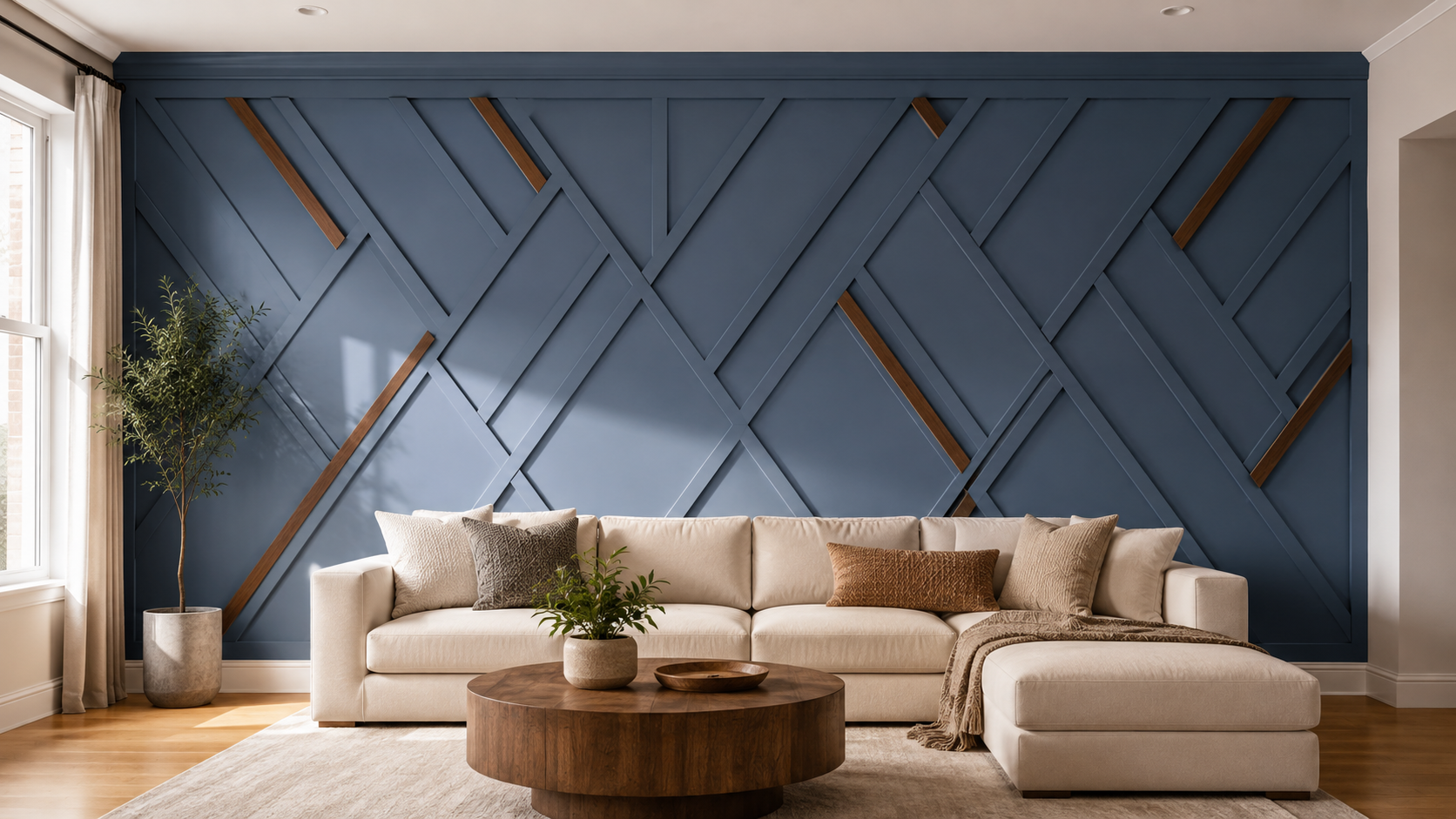
If a wall, an island, or a fireplace face in your home deserves more than flat paint, we would like to see it. Browse the geometric accent walls in our gallery, watch the Westfield island come together, or follow Radford Woodworks on Instagram and Facebook for new builds as they finish. When you are ready, send a photo through the wall quote form or contact Radford Woodworks and we will talk through the pattern that fits your room.