
The call comes every January. A homeowner stands at a new baseboard run, phone camera aimed at a hairline opening where two miters used to meet, asking what went wrong. Usually nothing did. Indiana trim carpentry has to hold together in a house that runs muggy in August and turns furnace-dry by January, and wood answers by shrinking. The job is to build so that movement lands where nobody sees it.
Why does trim crack and gap in Indiana winters?
Trim opens at the joints in winter because heated indoor air pulls moisture out of the boards, and the boards shrink across their width as it leaves. Wood is hygroscopic: its moisture level tracks the air around it.
At 70 degrees and 70% relative humidity, wood settles near 13.1% moisture content. Drop that room to 30%, ordinary once a furnace runs hard, and the target falls to about 6.2%. Outdoor air moves too: the USDA Forest Products Laboratory Wood Handbook lists Indianapolis at roughly 12.5% equilibrium moisture content in April and 15.5% in December, averaged over three decades of weather data.
Direction decides where the gap lands. Wood shrinks most along the growth rings, about half as much across them, and only slightly with the grain, where lengthwise shrinkage runs 0.1% to 0.2% for most species. A twelve-foot baseboard stays twelve feet. The eight-inch panel above it does not stay eight inches, and the miter tying them together is where the difference collects.
What does humidity do to wood?
Humidity changes the size of wood by changing how much water sits inside the cell walls. Below the fiber saturation point near 30% moisture content, wood swells as it takes on moisture and shrinks as it gives moisture up, every year, for as long as the woodwork is in the house. Denser species generally move more.
Finish slows the exchange without ending it, since protective coatings retard dimensional change in wood but do not prevent it. Wood installed at the moisture level it will live at afterward mostly stays put, which is why almost everything a trim carpenter does about humidity happens before the nail gun comes out.
Which 5 Indiana trim carpentry practices keep joints tight year-round?
Five practices carry most of the load: acclimating stock inside the space, matching material to the finish, back-priming, joinery that hides seasonal change, and a sprayed finish on every face.
1. Acclimate the material inside the house, not in the garage
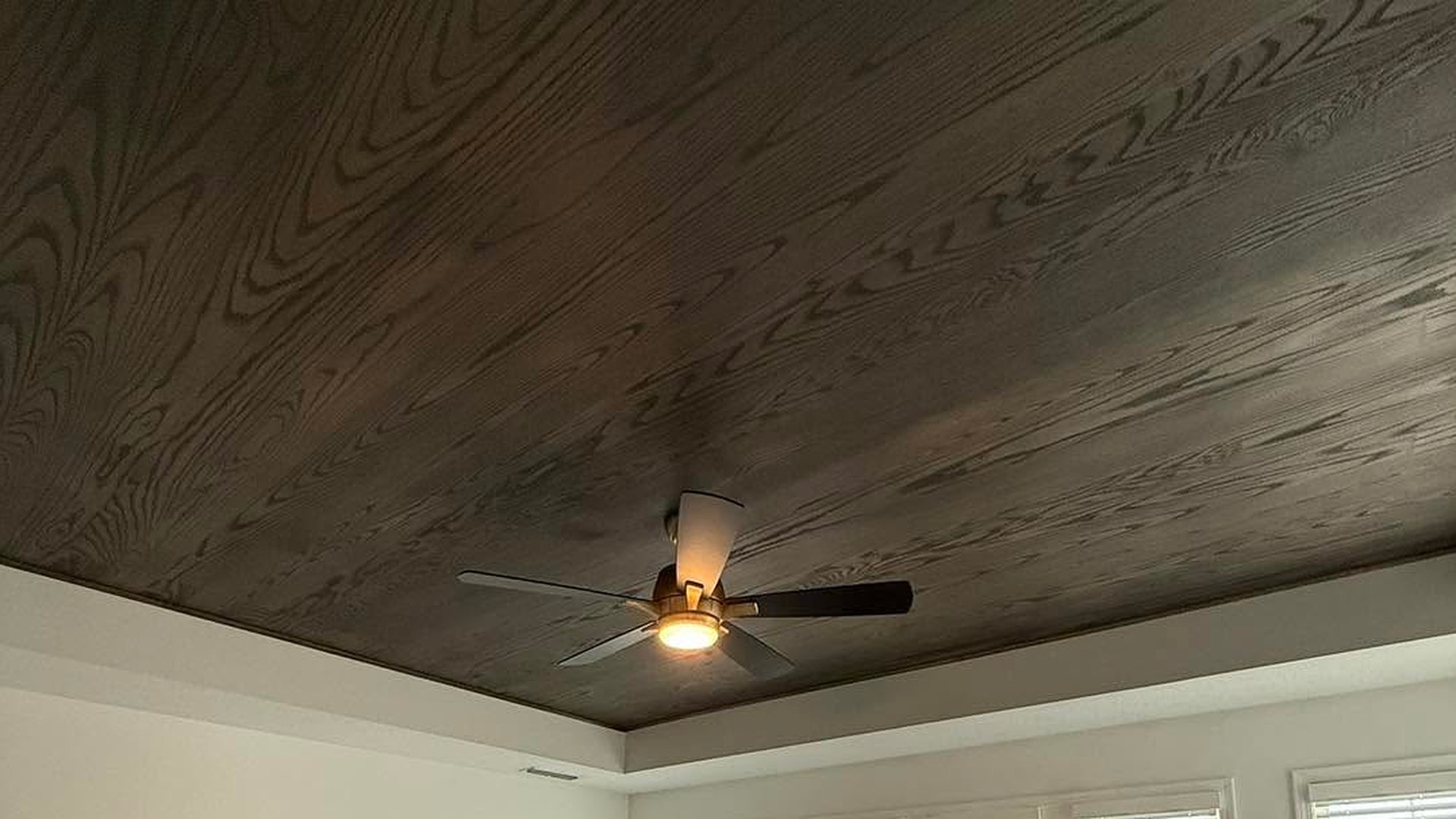
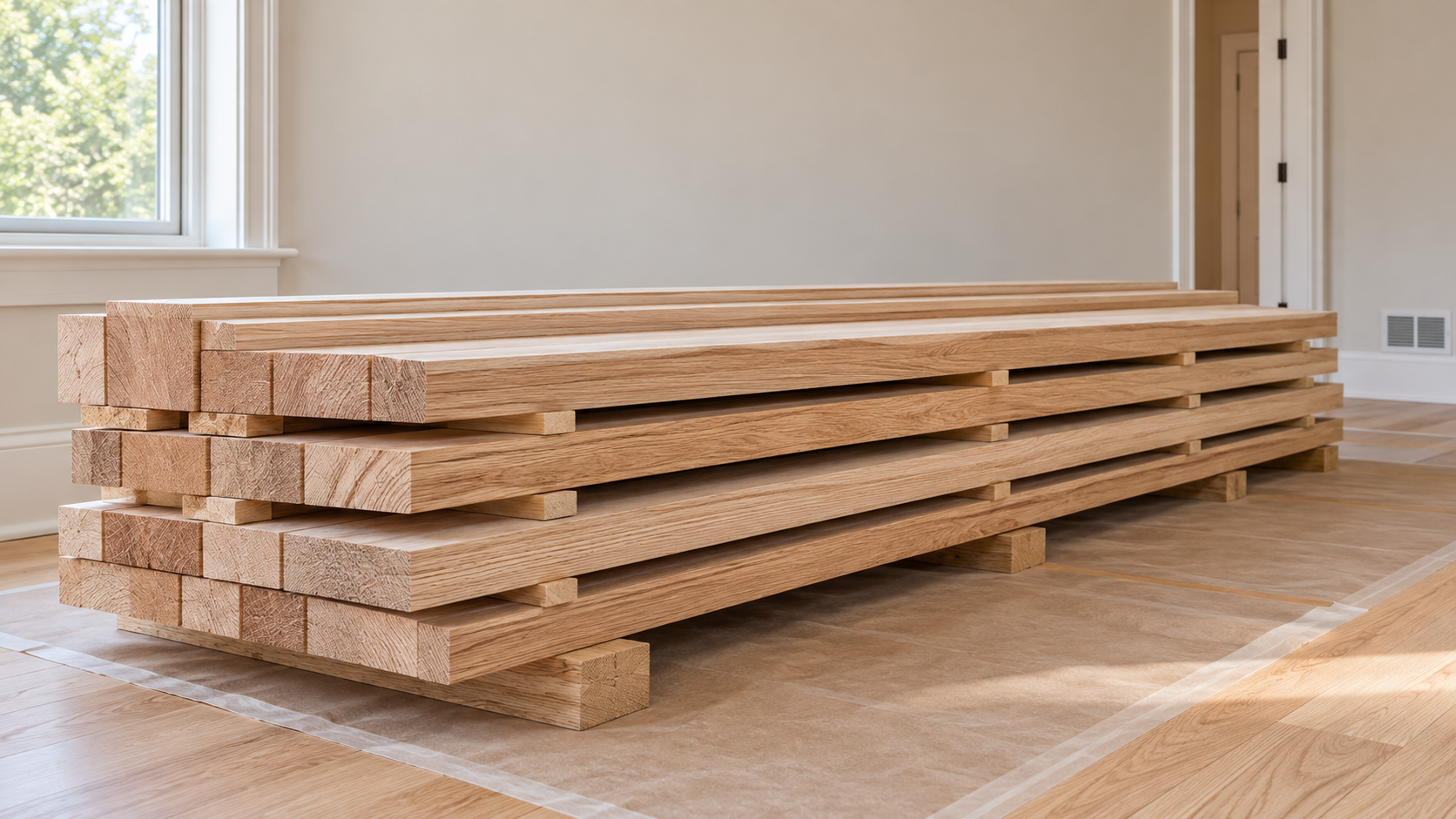
Stock gets stacked inside the conditioned space and left alone until it stops changing. On the red oak tongue-and-groove ceiling, that meant several days indoors before a board went up. Material installed ahead of that settles later, and the openings that follow are near impossible to fix without pulling the ceiling down.
No fixed waiting period exists. Fine Homebuilding contributor Tyler Grace measures wood and substrate instead of counting days, aiming for 6% to 10% moisture content in a conditioned space, since stock from an unheated warehouse often arrives at 12% to 14%. The Forest Products Laboratory puts interior trim near 8% at install time in most of the country.
2. Match the material to the finish before anything gets cut
Paint-grade and stain-grade work call for different stock, and that decision belongs at the quote stage. Poplar and engineered panel stock hold a crisp painted profile and move less than the oaks. Stain work goes to solid hardwood, the only place the grain lives. White oak shrinks more across the grain than red oak, so a wide stained panel gets designed differently than a painted one the same size.
3. Back-prime, and treat end grain as the weak point
Every unfinished face gets sealed, including the one that faces the wall forever. Grace primes drywall before trim goes on and back-primes bare lumber: the less moisture crosses between materials, the better the joint holds. End grain is where wood drinks fastest, since absorption runs quickest along the grain, which is why boards check at their ends during drying.
4. Build joints that hide the movement instead of fighting it
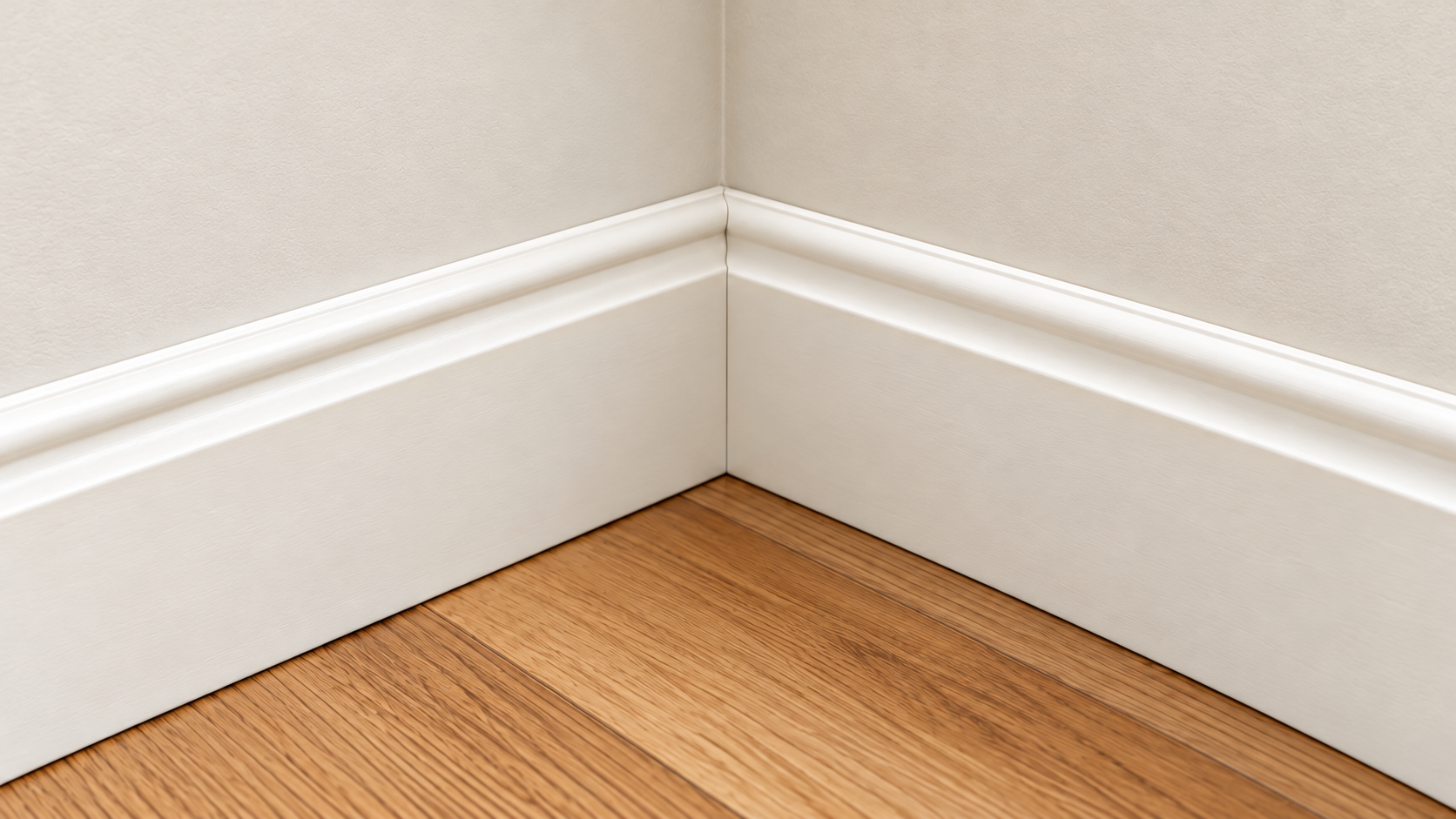
Inside corners get coped, not mitered, because a coped joint closes on itself as a wall shifts while a mitered one opens into a wedge. Wide casing and base get hollow-backed so the piece pulls flat against a wall that never is. The Forest Products Laboratory also recommends building large members up from smaller pieces and designing wide panels to stay free to move across the grain.
5. Spray the finish on every face, top and bottom
Radford Woodworks finishes on site with an airless sprayer running a fine finish low pressure tip, the setup cabinet shops use for an even surface with no brush marks, the same approach behind this on-site fireplace build-out in Westfield. The quieter payoff: a board sealed on both faces gains and loses moisture at a similar rate front and back, and a board that wets evenly cups less than one sealed on the show face alone.
Which materials move least?
Engineered panel stock and PVC move least, poplar sits in the middle, and solid oak moves most. Movement is only part of the call: the material also has to hold a profile, take a finish, and suit the room.
| Material | How it moves with humidity | Paint or stain | Best use in an Indiana home |
|---|---|---|---|
| Solid white or red oak | Moves most; white oak more across the grain than red | Stain | Ceilings, mantles, slat walls, beams |
| Poplar | Less than oak, steady once acclimated; dents easily | Paint only | Base, casing, board and batten |
| Engineered panel stock (MDF) | No grain direction, so no cupping; swells at cut edges if wet | Paint only | Flat panels, grid walls, wainscoting |
| Cellular PVC | Does not take on water | Paint | Splash zones, baths, laundry |
Should you run a humidifier in winter for your woodwork?
Yes, inside a range. Radford Woodworks asks clients to hold indoor humidity between 35% and 55% year-round, written into the Radford Woodworks warranty as a client responsibility. The EPA recommends keeping indoor relative humidity under 60%, ideally between 30% and 50%. Overlap the two and a winter target in the high 30s to mid 40s serves the woodwork and the household at once.
Pushing past that in a cold snap backfires, since the extra water finds the coldest surface in the room and condenses on the windows. A whole-home humidifier on the furnace beats a portable unit.
What can you do about existing trim that already gapped?
Steady the humidity first, and give the woodwork a full year before filling anything. Caulk pressed into a January gap gets squeezed back out in August when the joint closes, and the ridge it leaves is harder to fix than the original opening.
Once the house holds steady, painted joints take a flexible paint-grade caulk and a touch-up coat, while stained work gets a color-matched filler or wax stick. Panel gaps that reopen every winter point to stock that went up wet, which is a rebuild, not a filler job. The Radford Woodworks warranty covers loose boards, nail pops, and install-related touch-ups for twelve months, with one complimentary visit inside the first six.
Frequently asked questions
Why does the caulk line above my baseboard keep opening every winter?
That line sits between two materials moving at different rates: the wood base and the drywall behind it. When heated air dries the room, the base shrinks across its width and the caulk stretches until it tears. A flexible paint-grade caulk handles more travel than a rigid one, and steadier indoor humidity shortens the stretch.
What is the best season to install trim in Indiana?
Any season works if the house is conditioned and the material acclimates inside it first. Installing while the home sits near its year-round average leaves the woodwork less distance to travel, which favors spring and fall over July and January.
Does stained trim move more than painted trim in humidity?
The finish is not the reason; the material underneath is. Stained work is solid hardwood, which moves more than the poplar and engineered panel stock used under paint. Stain also makes an opening easier to spot, since a hairline gap in a dark finish reads as a light line, where painted joints hide behind caulk.
Can you put wood trim or paneling in an Indiana basement?
Yes, with the right material and a dry basement. The Forest Products Laboratory notes that wood in basements or over crawl spaces can carry higher moisture than the standard interior range. A summer dehumidifier, engineered panel stock or PVC near the floor, and full acclimation handle most of it.
Trim that stays tight through an Indiana year is not luck. It is dry material, a conditioned house, joints built with next August in mind, and finish on every face. If a room in your home deserves that, or last winter left a gap you would rather not see again, call Radford Woodworks at (317) 739-8555 or reach out through the contact page.